Bill Gates, AI and the Future of Car Design: Why the Automotive Industry Must Prepare for a More Turbulent Creative Era
Bill Gates’ recent essay, “The turbulent AI era is here. The choices we make now are critical,” is not written specifically for the automotive industry. Yet it may be highly relevant to car designers, digital modelers, design managers and automotive executives.
Gates argues that AI will either become one of the greatest equalizers ever invented, or one of the most disruptive sources of inequality, depending on the decisions society makes now. His central point is that AI is fundamentally different from earlier technologies because it does not merely replace physical work or improve productivity. It can replace, imitate and sometimes exceed human cognition.
That distinction matters enormously for car design.
The automotive design industry is already moving into an AI-assisted era. Major manufacturers are using AI to accelerate design exploration, simulation, virtual validation, production planning, software development, user-experience work and customer interaction. AI is no longer a futuristic tool sitting outside the studio. It is entering the design process itself.
The optimistic view is clear. AI could allow small design teams to work with extraordinary speed. It could help generate early themes, explore packaging alternatives, test aerodynamic ideas, create interior variations, support CMF development, simulate user reactions and produce high-quality visualization at speeds that were unthinkable only a few years ago.
But Gates’ warning is equally clear. A technology that can replace cognition does not only improve work. It changes the structure of work. It affects employment, education, inequality, authorship, responsibility and human development.
For automotive design, the key question becomes:
How do we use AI to expand human creativity without removing the human learning, judgment and responsibility that make great design possible?
AI Is Different Because It Enters the Realm of Thought
Gates frames AI as a new kind of technology because it can perform tasks that previously required trained human reasoning. Earlier waves of automation replaced muscle, repetition or calculation. AI reaches deeper. It enters areas such as analysis, communication, judgment support, pattern recognition and creative generation.
That is why the design industry should pay attention.
For decades, car design has been protected by the belief that creativity is uniquely human. A car designer had to understand proportion, stance, visual tension, surface behavior, brand character, package constraints, ergonomics and emotion. A digital modeler had to translate design intent into volume, reflection and surface discipline. A visualization specialist had to understand light, mood and storytelling.
AI does not yet replace all of that. But it does begin to affect parts of it.
It can generate exterior themes. It can produce mood boards. It can suggest interior environments. It can create quick renderings. It can summarize competitor vehicles. It can build early visual narratives. It can support software interaction concepts. It can help turn rough ideas into persuasive images.
This changes the economics of early design work. What once took several people several days may soon take one person one afternoon. That sounds efficient, and often it is. But it also removes many of the small learning loops through which young designers and modelers normally become good.
A design studio is not only an output machine. It is also an apprenticeship system.
If AI absorbs too much of the junior work, the industry may save money in the short term while damaging its future talent pipeline.
The Risk to Entry-Level Designers
One of Gates’ strongest concerns is that AI may hit entry-level and mid-level workers especially hard. That should worry automotive design leaders.
In a traditional car design studio, younger designers learn by doing the work. They sketch. They make mistakes. They present themes. They receive critique. They build taste through repetition. They learn which proportions work and which do not. They discover the difference between a good image and a good car.
Digital modelers learn in a similar way. Early work teaches them how to interpret a sketch, how to resolve a section, how to control reflections, how to preserve design intent and how to negotiate between beauty and feasibility.
If AI starts doing much of the first exploration, the first visualization, the first benchmarking and the first presentation work, young designers may lose the very experience that teaches them how to become senior designers.
That is one of the most important automotive implications of Gates’ argument.
The danger is not simply that AI will replace people. The danger is that AI may remove the developmental stages that create future experts.
Smaller, Faster Studios
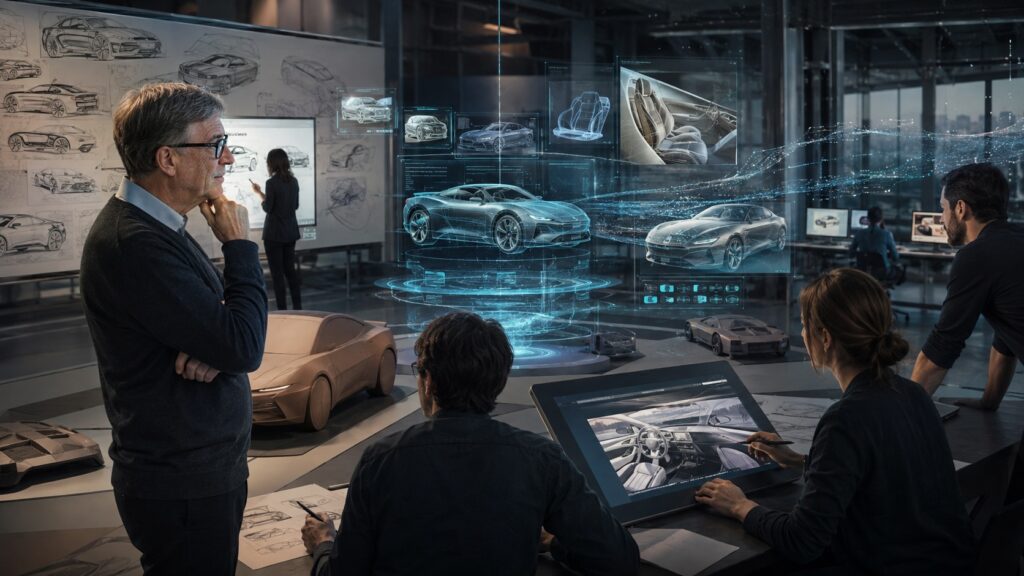
The design studio of the future may become smaller, faster and more data-driven.
A senior designer may be able to generate hundreds of design directions in a short time. A small advanced team may be able to produce the volume of work that previously required a large studio. A design manager may ask an AI system to combine competitor analysis, market positioning, customer preferences, package constraints and visual themes into one fast design exploration.
This will increase speed, but it will also change the nature of design leadership.
The bottleneck will no longer be the production of options. The bottleneck will be judgment.
When AI can generate endless alternatives, the important question is no longer “Can we create enough ideas?” The important question becomes “Which idea is worth developing?”
That places greater value on senior design judgment, brand understanding and emotional intelligence. A weak designer may hide behind AI-generated output. A strong designer will use AI as a tool, but still know what to reject.
In this new environment, the most valuable people may not be those who can produce the most images. They will be those who can recognize the one idea that has meaning.
The Risk of Visual Sameness
There is another danger. AI can produce plausible design very quickly, but plausible design is not the same as original design.
If every manufacturer uses similar AI systems trained on similar visual references, the result could be a new form of global design sameness. “Premium EV,” “sporty crossover,” “rugged SUV,” “minimalist interior” and “futuristic mobility lounge” can all become visual clichés produced at industrial speed.
This is already a risk in the current car industry. Many new vehicles are clean, competent and aerodynamic, yet lack strong identity. AI could amplify that problem if companies use it mainly to generate safe, marketable averages.
Brand identity will therefore become more important, not less.
The challenge for design leaders will be to prevent AI from pulling every brand toward the same visual center. A Mercedes, BMW, Audi, BYD, Hyundai, Toyota or Polestar cannot simply become a variation of a generic AI-generated premium EV. Each must still express a specific brand culture, design philosophy and emotional promise.
AI can help explore identity, but it cannot replace the need for identity.
Digital Modelers Will Need to Move Upstream
AI will also change the role of the digital modeler.
Pure execution work may become more automated. Early 3D proposals, rough volume studies and quick surface iterations may increasingly be assisted by AI or generative tools. But this does not mean the best digital modelers become less important.
It means they must move upstream.
The future digital modeler will need to understand design intent, surface quality, data structure, visualization, package constraints, production logic and real-time review environments. The role may become less about simply building what is requested and more about shaping the design process itself.
A strong digital modeler will become a translator between sketch, AI output, engineering reality and physical form.
That is a higher-level role, not a lower one.
The danger is for those whose work remains purely mechanical. The opportunity is for those who combine craft, design sensitivity and technological fluency.
Physical Craft May Become More Valuable
As AI-generated images multiply, physical design craft may become more important.
A car is not an image. It is a physical object that exists in changing light, real space and human scale. Reflections move across surfaces. Door sections need volume. Seats must support bodies. Interfaces must be understood at speed. Materials must feel right. A cabin must work emotionally as well as digitally.
AI can generate beautiful images that do not yet understand these realities fully.
That is why clay, hard models, physical bucks, seating studies and real-world evaluation still matter. The best design studios will not abandon physical judgment. They will use AI to arrive at better physical decisions faster.
The weakest studios will confuse visual output with design quality.
The Interior as an AI Environment
Gates is especially concerned about the effect of AI on human relationships, mental development and critical thinking. That may sound far removed from car design, but it is not.
The vehicle interior is becoming one of the most important places where humans will interact with AI.
Future cars will have increasingly intelligent assistants, adaptive interfaces, predictive navigation, personalized comfort systems, voice interaction, driver monitoring, safety coaching and possibly emotionally aware digital companions. The cabin will no longer be only a physical space. It will become a relationship space between human and machine.
That creates new responsibilities for automotive UX designers.
Should the car merely assist the driver, or should it actively influence behavior? Should it calm the user, challenge the user, persuade the user or sell to the user? Should it remember emotional patterns? Should it interact with children in the rear seat? Should it adjust its personality to the driver?
These questions are not just technical. They are ethical.
As AI enters the car interior, designers must think beyond convenience. They must design for trust, transparency, dignity and control.
A vehicle that is too automated, too opaque or too emotionally manipulative may feel impressive at first, but unsettling over time. In that sense, future cockpit design will not only be about screens, graphics and voice commands. It will be about the human relationship with intelligence inside the car.
The Software-Defined Vehicle Becomes the AI-Defined Vehicle
The industry has spent years talking about software-defined vehicles. Gates’ thinking suggests that the next step may be the AI-defined vehicle.
A software-defined vehicle can be updated, personalized and connected. An AI-defined vehicle goes further. It may interpret the driver, adapt to behavior, predict needs, manage energy, plan routes, monitor safety, optimize comfort, mediate entertainment, assist with driving and possibly influence the emotional atmosphere of the cabin.
That changes the role of design.
Exterior design still matters. Proportion still matters. Surface quality still matters. But the vehicle experience becomes increasingly defined by intelligence, interaction and behavior.
The car is no longer just something you look at and drive. It becomes something that looks back, learns and responds.
That is a profound design challenge.
Human Reserved: A Useful Idea for Car Design
One of Gates’ most interesting ideas is that some tasks should remain human not because machines cannot do them, but because society may decide that the human role is too important to remove.
He refers to this as the idea of roles being reserved for humans.
This concept could be highly valuable for car design.
The automotive industry may need to define its own Human Reserved areas. Not every decision should be automated simply because automation is possible. Not every interface should be optimized by data. Not every surface should be generated by an algorithm. Not every customer interaction should be managed by AI.
In car design, Human Reserved areas should include final design judgment, brand character, exterior proportion sign-off, interior emotional direction, physical model evaluation, ethical UX decisions, safety-critical interface choices, accessibility decisions and design mentorship.
AI can support all of these areas, but responsibility should remain human.
A useful principle might be:
AI may generate, evaluate and accelerate, but humans must decide what the vehicle means.
The Employment Question
Gates also raises the issue of how society taxes and rewards labor versus machines. His argument is that current economic systems often make it easier to replace people with automation than to preserve human work. Whether or not one agrees with every policy implication, the point is relevant to automotive design and manufacturing.
The automotive industry has always been deeply tied to automation. Robots transformed manufacturing. Software transformed development. AI may now transform both the factory and the studio.
If AI systems reduce headcount, governments may eventually ask whether the economic benefits should be taxed differently. If human labor is replaced by machine intelligence, societies will need to fund retraining, education and safety nets somehow.
For car companies, this could become more than a productivity question. It could become a social and political question.
A brand that presents itself as sustainable, responsible and human-centered may eventually have to explain not only how its cars are built, but also how its AI systems affect workers, communities, energy use and opportunity.
The Energy Cost of AI
Gates also mentions concern about the energy and water required by data centers. That point should not be ignored by the car industry.
Automotive companies are increasingly using cloud computing, simulation, digital twins, AI training, synthetic data, virtual validation, rendering and connected vehicle systems. These tools can reduce physical prototypes and improve efficiency, but they also require large amounts of computing power.
As sustainability becomes central to automotive branding, the environmental cost of digital development will become harder to hide.
A company cannot credibly talk about clean mobility while ignoring the footprint of the digital systems behind its vehicles. AI-powered development may be cleaner in some ways than old physical processes, but it is not impact-free.
Sustainable design will increasingly include both physical materials and digital infrastructure.
What the Best Automotive Companies Will Do
The strongest car companies will not treat AI as a shortcut to cheaper design. They will treat it as a way to strengthen the design process.
They will use AI to explore more possibilities, but still protect human judgment. They will accelerate simulation, but still test in the real world. They will create richer user experiences, but still protect privacy and trust. They will reduce repetitive work, but still train young designers. They will use generative tools, but still defend brand identity.
In the best case, AI becomes the most powerful design amplifier the industry has ever had.
It can help designers see more, test more, learn faster and make better decisions. It can bring engineering, sustainability and design closer together. It can make advanced design tools available to smaller companies and independent studios. It can allow boutique manufacturers, start-ups and specialist vehicle builders to work at a level that previously required far larger organizations.
That is the optimistic future.
What the Weakest Companies Will Do
The weaker response will be different.
Some companies will use AI mainly to reduce cost. They will cut junior roles, reduce external creative work, automate visual output and ask smaller teams to deliver more with less. They will accept AI-generated sameness because it is fast and cheap. They will confuse attractive imagery with design quality.
This may produce vehicles that look competent but feel empty.
The risk is not that AI will produce ugly cars. The risk is that it will produce visually acceptable cars without strong authorship, cultural meaning or emotional truth.
That may be worse.
A bad car can at least be clearly wrong. A generic AI-assisted car may be smooth, polished and forgettable.
The Future Designer
The future car designer will need a broader skill set.
Classical design ability will still matter: proportion, stance, surface, form, sketching, package understanding, ergonomics and visual storytelling. But designers will also need to understand AI tools, data, software behavior, user psychology, ethics, sustainability and digital experience.
The designer of the future will not simply draw cars. They will direct intelligent systems, judge outcomes, protect meaning and shape human experience.
The best designers will become more powerful. The average designer may become more vulnerable. The industry will increasingly reward those who can combine taste, technology and judgment.
Final Assessment for Car Design TV
Bill Gates’ article should be read by the automotive design industry as both a warning and an opportunity.
AI will almost certainly make car design faster, more intelligent and more closely connected to engineering, simulation and software. It will allow smaller teams to do extraordinary work. It will help explore new forms of mobility, sustainability and personalization.
But it may also reduce entry-level opportunities, weaken craft development, flatten brand identity, increase surveillance, create manipulative user experiences and shift creative power from people to platforms.
The future should not be “AI replaces designers.” It should also not be “designers ignore AI.”
The right path is more demanding.
AI should become a powerful amplifier of automotive creativity, but the human designer must remain responsible for meaning, judgment, ethics and emotional truth.
That may become one of the central design challenges of the next decade.