Personal Drones, eVTOLs and the Future of Transport: Freedom, Fantasy or Low-Altitude Chaos?

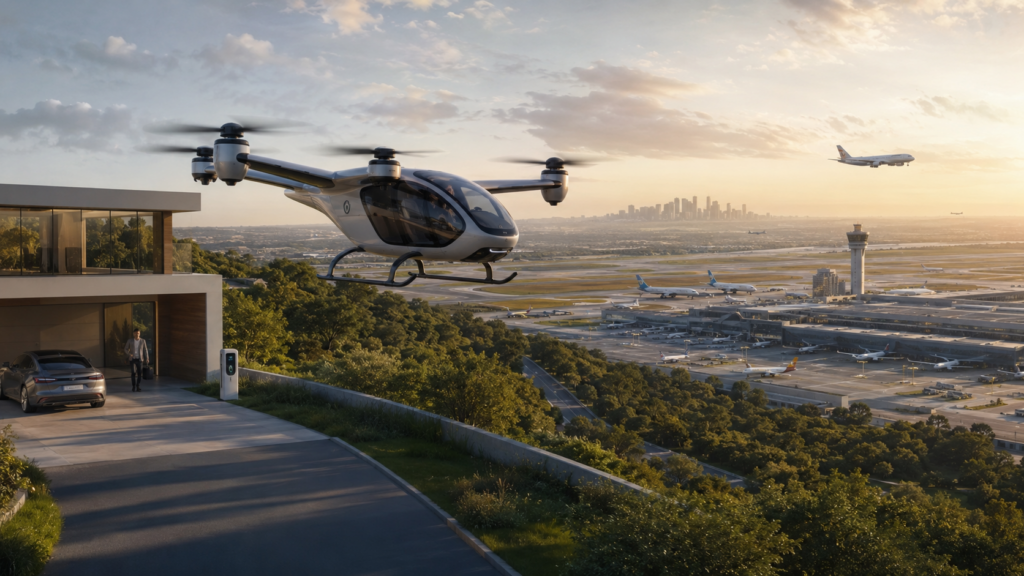
The dream of flying over traffic is old. The question is whether it should become personal.
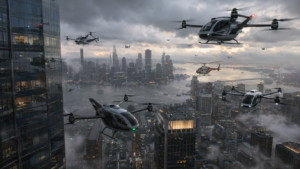
During a recent discussion with Joop Donkervoort about the future of personal transport, the idea came up that the long-term answer may not be cars at all, but drones. Not small hobby drones, but personal aerial vehicles: electric VTOL aircraft, passenger drones, flying cars and autonomous air taxis.
It is an attractive idea in theory. Roads are congested. Cities are expanding. Airports remain difficult to reach. Cars waste enormous amounts of time sitting in traffic. If personal mobility could simply lift itself into the third dimension, much of that congestion might appear to disappear.
But to anyone who has spent a lifetime thinking about vehicle design, usability and human behavior, it also sounds like a potential nightmare.
Today, many drivers struggle to behave safely on flat roads, with lanes, traffic lights, signs, mirrors, ABS, stability control, lane keeping, emergency braking and decades of traffic law. Moving that same public into multiple layers of low-altitude airspace is not a simple upgrade. It is a completely different safety problem.
A road accident usually stays on the road. A flying vehicle failure becomes a falling object. A wrong turn in a car may damage a bumper. A wrong approach in low-altitude airspace near an airport could become an aviation incident. The design question is therefore not only whether eVTOLs can fly. Many already can. The real question is whether personal aerial mobility can ever become safe, scalable, socially acceptable and useful enough to become part of normal life.
The answer is nuanced. Electric vertical take-off and landing aircraft are real. Certification frameworks are being built. Air-taxi companies are moving toward commercial operations. China is already further ahead with pilotless passenger-carrying aircraft in controlled contexts. But the idea of millions of privately owned, individually piloted personal drones buzzing from driveways to airports is, in my view, not a realistic or desirable mass-transport future.
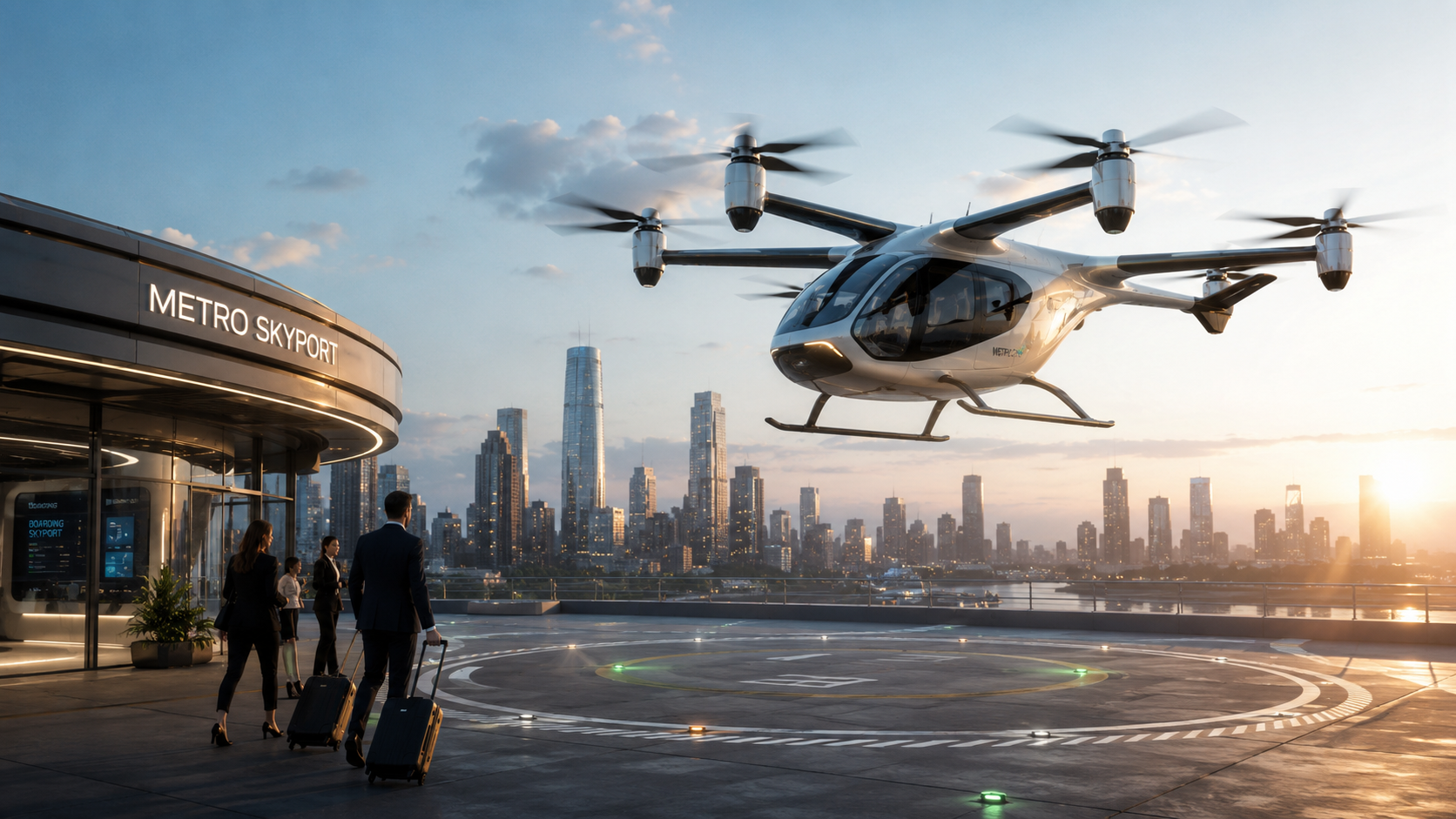
The more likely future is narrower, more controlled and much less romantic: regulated eVTOL services operating between approved vertiports, airports and mobility hubs, initially with pilots, later with higher levels of automation, serving premium short-distance routes, airport transfers, emergency services, island connections and special regional links.
That could become real. But it will not be the airborne version of private car ownership.
VTOL, eVTOL and “flying cars”: what are we really talking about?
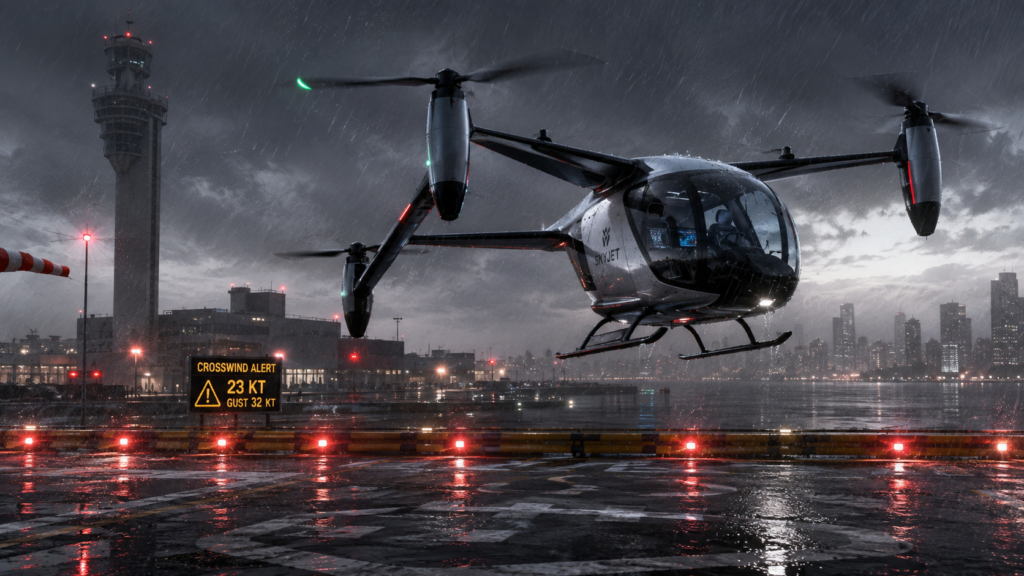
VTOL means vertical take-off and landing. A helicopter is a VTOL aircraft. What is new is the rise of eVTOLs: electric vertical take-off and landing aircraft, usually using multiple electric rotors, distributed propulsion, batteries, software-based control systems and often a wing for efficient forward flight.
There are several different categories being mixed together in public discussion.
The first is the air taxi: a certified aircraft operated by a professional company, flying between approved locations. This is the Joby, Archer and Volocopter idea.
The second is the autonomous passenger drone: a highly automated aircraft carrying one or two passengers, often without an onboard pilot. EHang in China is the clearest example of this path.
The third is the roadable flying car: a vehicle that can drive on roads and also fly. This remains the most emotionally powerful image, but also one of the least convincing from a design and engineering point of view, because road safety, crash structure, weight, packaging, wings, rotors and aviation redundancy fight each other brutally.
The fourth is the modular flying vehicle, where a road vehicle carries or houses a separate flying module. XPeng AeroHT’s “Land Aircraft Carrier” concept belongs more in this category than in the traditional flying-car fantasy.
From a design perspective, the air taxi is the most plausible. The private flying car is the most seductive. The autonomous passenger drone is the most radical. The modular flying car is the most theatrical.
But all of them run into the same central question: how do we safely manage large numbers of flying vehicles near people, buildings, roads, power lines, weather systems, emergency helicopters and real aircraft?

The latest developments: this is no longer science fiction
The eVTOL sector is not just renderings and investor decks anymore. Several important regulatory and technical milestones have already happened.
In the United States, the FAA issued a final rule in October 2024 for “powered-lift” aircraft, creating a framework for pilot certification, operating rules and integration into the National Airspace System. The FAA described powered-lift aircraft as the first new aircraft category in almost 80 years and said the rule was intended to pave the way for wide-scale Advanced Air Mobility operations.
The FAA also released an Advanced Air Mobility implementation plan called Innovate28, aimed at enabling AAM operations at scale at one or more locations by 2028. The agency’s airspace blueprint expects air taxis, as operations increase, to fly in corridors between major airports and city-center vertiports rather than simply roaming freely above cities.
Europe is also building the legal and operational framework. EASA has introduced guidance material and acceptable means of compliance for manned VTOL-capable aircraft, emphasizing issues such as preflight preparation, vertiports, diversion locations and fuel or energy management. Europe also has a U-space framework for unmanned traffic management, intended to allow drones and manned aircraft to operate safely in designated airspace.
That last point is critical. The future of aerial mobility is not simply an aircraft problem. It is an airspace-management problem.
Joby, Archer, EHang — and the companies that struggled
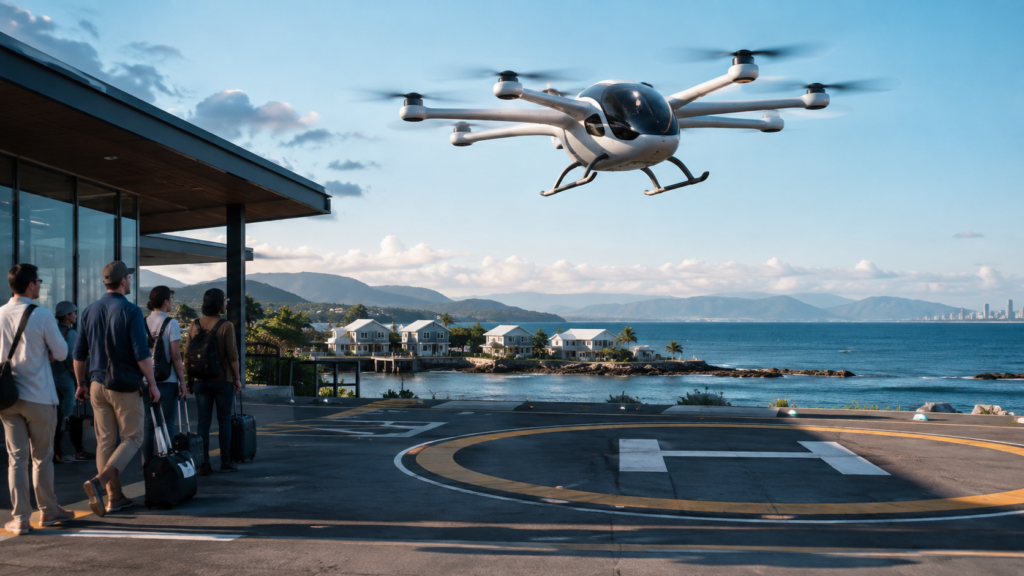
Joby Aviation remains one of the most closely watched Western eVTOL companies. In March 2026, Joby announced that its first FAA-conforming aircraft had begun flight testing for Type Inspection Authorization, describing this as a major step in the final stage of FAA type certification. Joby also said in its first-quarter 2026 update that initial operations were expected to begin in 2026 through the U.S. eVTOL Integration Pilot Program, even ahead of full type certification in selected pilot-program contexts.
Archer Aviation is pursuing a similar air-taxi future with its Midnight aircraft. In 2026, Archer said it had completed Phase 3 of the FAA’s four-phase type certification process and expected initial U.S. operations in 2026. Archer is also pushing hard in the UAE, where the country’s aviation regulator moved Midnight into a Restricted Type Certificate program as part of a broader path toward commercial readiness in areas including aircraft certification, operations, maintenance, flight crew training, airspace, vertiports, security and oversight.
China has moved even faster in some respects. EHang’s EH216-S passenger-carrying pilotless eVTOL has received type certification, production certification, standard airworthiness certification and operator certification from China’s CAAC, according to EHang. EHang’s operators received Air Operator Certificates in 2025, opening the door to ticketed low-altitude sightseeing and other controlled passenger operations in China.
At the same time, the industry has already produced cautionary stories. Lilium, one of Germany’s most visible eVTOL start-ups, filed for insolvency after failed fundraising efforts. Volocopter also filed for insolvency in late 2024 after being unable to raise enough funding to maintain regular operations. These failures matter because they show that the difficulty is not only aerodynamic or regulatory. It is financial, industrial and operational.
An eVTOL company is not simply building a vehicle. It must certify an aircraft, build a production system, create maintenance infrastructure, train pilots or certify autonomy, integrate with airspace, build vertiports, satisfy regulators, convince cities, reassure the public, control noise, manage batteries and still generate enough revenue to survive.
That is an enormous challenge.

Why the “everyone gets a drone” future is frightening
The instinctive concern is correct: if many people cannot reliably handle a car in two dimensions, why would we let them operate in three?
The answer, from the eVTOL industry, is usually: we will not. At least not in any serious near-term scenario.
The realistic future is not millions of individuals free-flying wherever they want. It is tightly controlled airspace, certified aircraft, defined corridors, automated traffic management, required flight plans, geofenced routes, professional operators and eventually certified autonomy.
In other words, the future air taxi will probably be closer to a miniature airline or airborne Uber-helicopter network than a private car.
That distinction is essential.
A privately owned personal drone that takes off from a suburban garden and flies directly to Schiphol or Heathrow would be a regulatory nightmare. It would need permission to enter controlled airspace. It would need separation from aircraft. It would need weather minima, emergency diversion sites, noise compliance, battery reserve, communication with air traffic services, detect-and-avoid capability, cyber-secure navigation and a certified fail-safe strategy for loss of propulsion, loss of GPS, loss of communications, software faults and bad weather.
A managed eVTOL service from an approved vertiport to an airport vertiport is a different proposition. That route could be surveyed, approved, monitored and integrated into airspace procedures. It could be operated by trained pilots initially. It could have scheduled slots, backup landing sites and clear separation from conventional aircraft. The FAA’s own airspace blueprint points toward corridors between airports and vertiports as traffic increases, not toward free-for-all personal flying.
So your instinctive fear is valid — but mainly against the wrong version of the idea. The frightening version is private, unstructured aerial motoring. The plausible version is controlled air mobility.
The airport problem: how would you fly from home to a business flight?
The airport example is the perfect test case.
Imagine living near Loosdrecht and wanting to reach Schiphol for a business trip. In the fantasy version, you walk outside, step into a personal drone and fly directly to the airport terminal.
That is almost certainly not how it would work.
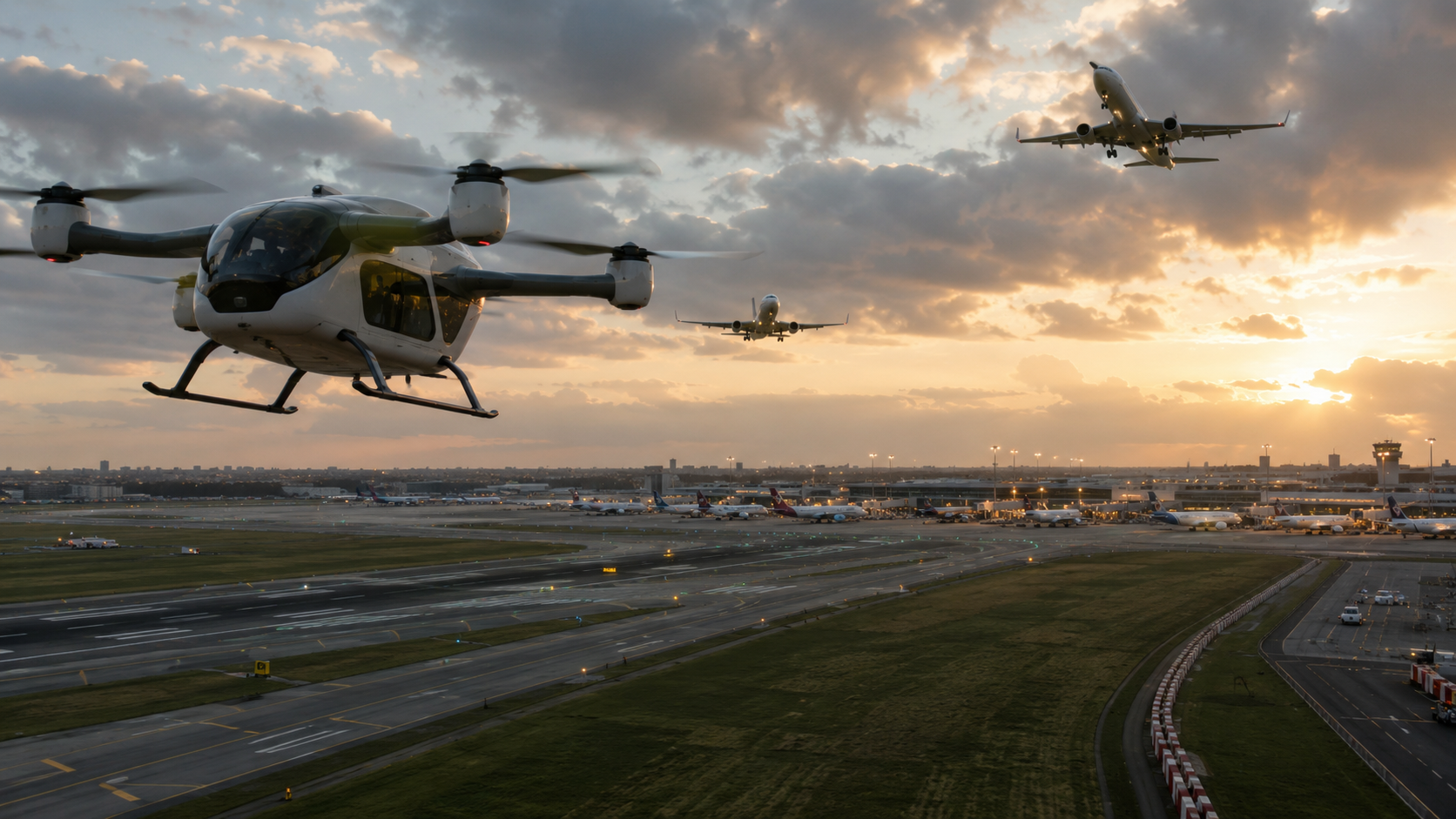
Schiphol is surrounded by controlled and highly sensitive airspace. It is one of Europe’s major airports. Allowing private aerial vehicles to approach from all directions would be unacceptable. Even helicopters do not operate around major airports casually; they follow procedures, clearances and defined routing.
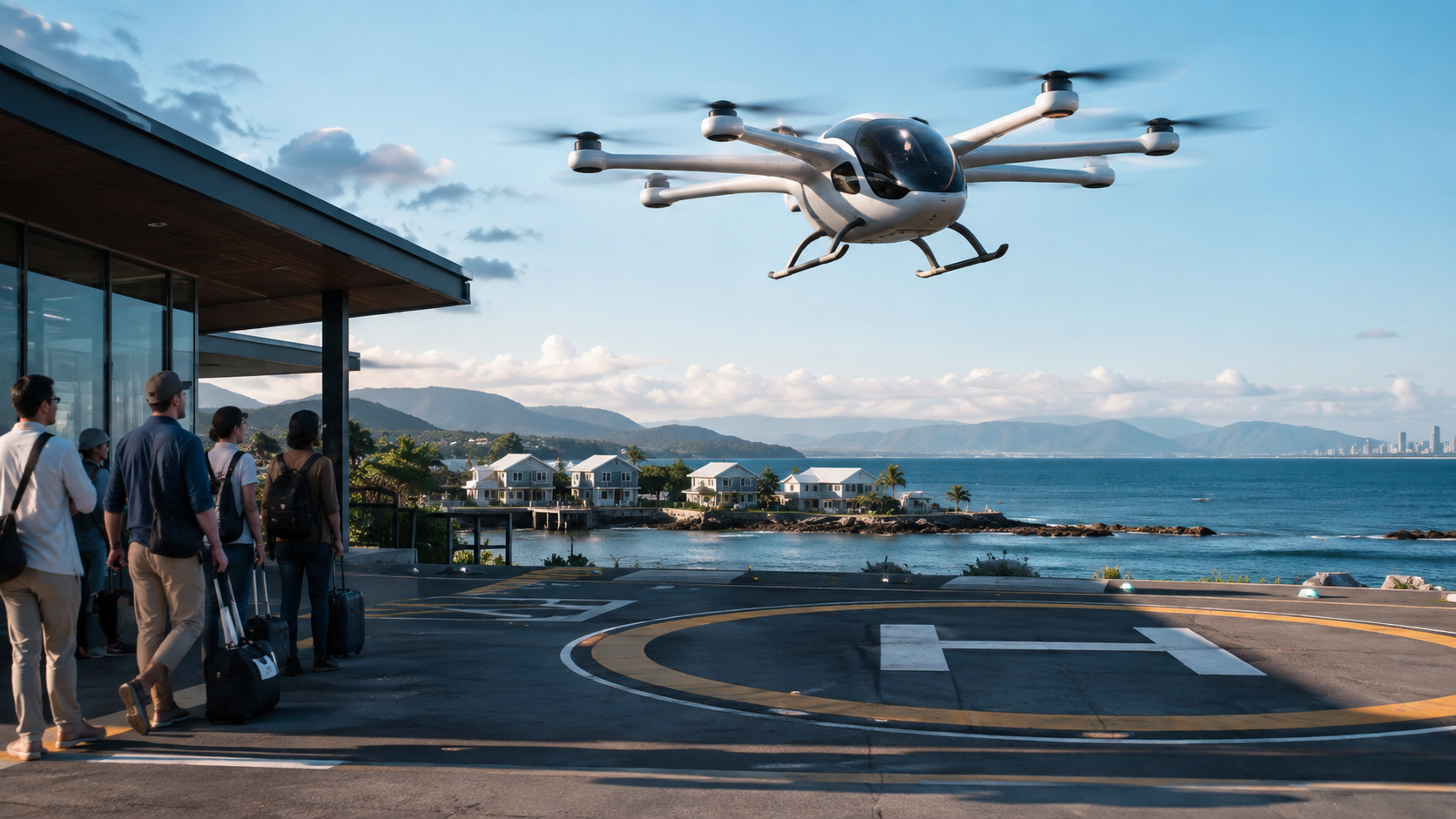
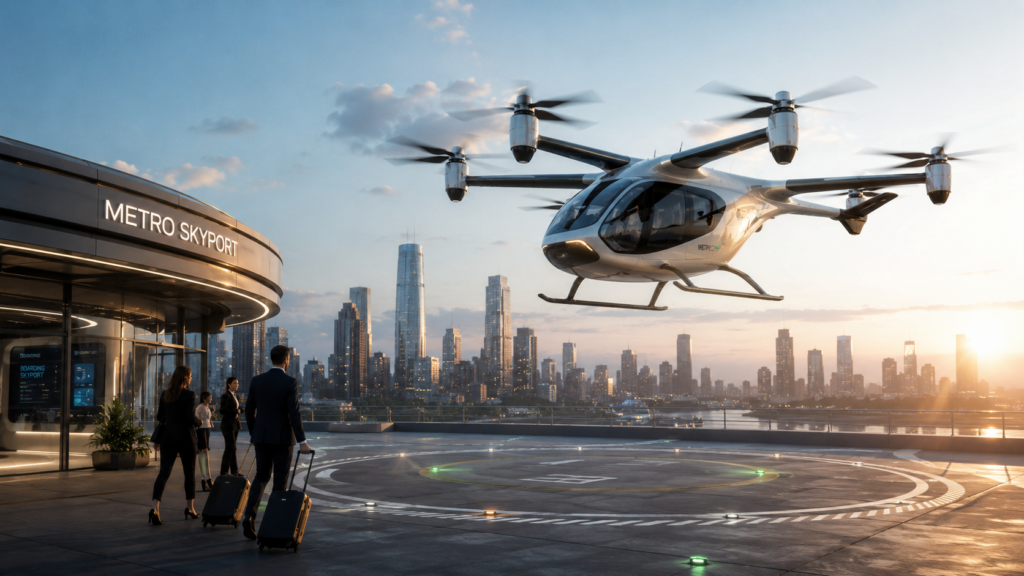
In a realistic eVTOL future, you would probably travel from your home to a nearby vertiport or mobility hub by car, taxi, autonomous shuttle or perhaps bicycle. From there, a certified eVTOL would fly a defined route to an airport vertiport or nearby intermodal hub. The route would be coordinated with air traffic management and separated from conventional aircraft operations. It would not be a casual personal flight; it would be a managed transport service.
That means the value proposition changes.
The eVTOL does not replace the entire journey. It replaces the congested middle section. It becomes a premium airport-transfer layer, not a door-to-door personal freedom machine.
That is not necessarily bad. It may still be valuable. A 15-minute aerial transfer replacing a 75-minute road journey during peak traffic could be attractive. But it is not the same as private car freedom. It is closer to a helicopter transfer made cleaner, quieter and potentially cheaper.
Safety: aviation standards versus consumer expectations
The automotive industry and the aviation industry think about safety differently.
Cars are built for mass use by ordinary people in an uncontrolled environment. They rely on driver training, road rules, crash structures, active safety systems, insurance, enforcement and statistical tolerance of accidents.
Aviation is much less tolerant of failure. Aircraft certification demands redundancy, documented systems engineering, maintenance discipline, operating procedures, pilot training and traceable compliance. That is why aviation safety is expensive.
This creates a fundamental tension for eVTOLs. The business model often dreams of ride-hailing scale, but the safety model must satisfy aviation-level discipline.
Recent research into eVTOL operations under a systems-theoretic safety analysis found hundreds of unsafe control actions and causal factors, with gaps in areas such as certification, training, collision avoidance, energy management and automation. That does not mean eVTOLs are unsafe. It means the system surrounding them is complex and still maturing.
The safety question is not simply: can the aircraft stay in the air? It is: can the whole ecosystem behave safely when hundreds or thousands of operations occur daily, in changing weather, with multiple operators, different aircraft, battery degradation, software updates, emergency diversions, passenger delays and ground congestion at vertiports?
That is where the real challenge lies.
Noise and public acceptance may be as important as crash safety
Even if eVTOLs become safe, they still have to be tolerated.
A single aircraft can sound impressive. A city filled with repetitive rotor noise can become unbearable. Helicopter noise is one reason urban helicopter operations are politically controversial in many cities. eVTOLs promise to be quieter, but “quieter than a helicopter” does not automatically mean “acceptable over my house every five minutes.”
NASA has been studying this very issue. Its Advanced Air Mobility work has included acoustic testing with Joby’s aircraft, using large microphone arrays to measure how eVTOLs sound in different phases of flight. NASA also ran public response testing in Los Angeles, New York City and Dallas-Fort Worth to understand how people respond to air-taxi noise.
Noise is not only about decibels. It is also about character, frequency, repetition, predictability and context. A faint but high-pitched drone-like sound repeated all day may irritate people more than a louder but less frequent vehicle. This is where design and engineering overlap with psychology.
For eVTOLs to be accepted, cities will likely demand route planning, altitude restrictions, operating-hour limits, noise corridors and limits on traffic density. That again pushes the future away from personal freedom and toward managed networks.
Energy and environmental reality
Electric air taxis are often presented as clean mobility because they have zero tailpipe emissions. That is technically true during operation, but it is not the full environmental story.
Vertical take-off is energy-intensive. Hovering is inefficient compared with rolling on wheels. For short urban trips, an eVTOL will usually consume more energy per passenger than an electric car or train. A Paris-focused study found that eVTOLs can save time, especially on longer routes, and can outperform helicopters environmentally, but in urban contexts they may consume more energy than electric cars and remain highly dependent on how they are integrated into the wider transport system.
This suggests a sensible hierarchy.
For one person going a few kilometers across town, a bicycle, tram, metro, train, EV taxi or autonomous shuttle will usually make more sense. For a 40- to 100-kilometer airport transfer through severe congestion, or a connection across water, mountains or fragmented geography, an eVTOL may begin to make sense.
So eVTOLs should not be judged as replacements for cars everywhere. They should be judged as replacements for helicopters, premium airport transfers, difficult regional links and selected time-critical journeys.
The vertiport problem: the sky still needs stations
Flying cars are often sold with the illusion that they eliminate infrastructure. In reality, they require a new kind of infrastructure.
They need vertiports. They need charging. They need fire safety. They need passenger handling. They need access control. They need emergency procedures. They need maintenance facilities. They need noise buffers. They need weather monitoring. They need grid capacity. They need integration with taxis, trains, parking, luggage handling and airport security.
The FAA’s Innovate28 plan explicitly includes the steps needed to enable AAM operations at scale, and the FAA has even been working with the U.S. Department of Energy’s National Renewable Energy Laboratory to understand how aircraft electrification affects vertiports, heliports and airport electrical grids.
This is where the design dream becomes urban planning.
A car can park almost anywhere. An aircraft cannot. A vertiport has to be in the right place, but the right place is often exactly where land is expensive, residents are sensitive, buildings are dense and airspace is complicated.
This alone will limit eVTOL scale.
What about autonomy?
Full autonomy is the long-term promise, but also the hardest part.
A road vehicle can stop by the side of the road if something goes wrong. An aircraft cannot simply stop in mid-air unless it is designed to hover, and hovering consumes energy. It needs immediate fail-safe behavior.
Autonomy in the air must handle weather, bird strikes, rotor faults, battery issues, GPS errors, communications loss, cyberattack, other aircraft, emergency helicopters, drones, cranes, temporary flight restrictions and rapidly changing landing-site availability.
The first generation of Western air taxis will likely use pilots because certification is easier, public trust is higher and regulators already understand piloted operations. Autonomy will arrive gradually, perhaps first in cargo, then limited passenger services in tightly controlled environments, and only later in more complex urban networks.
China’s EHang approach is already pilotless, but that is within a different regulatory and operational environment and does not automatically translate to Europe or the United States.
The fully autonomous personal drone is therefore not impossible, but it is much further away than the promotional language often suggests.
The design consequence: personal transport becomes less personal
There is a deeper design issue here.
The car is personal because it gives the user control. You choose when to leave, where to go, which route to take, where to stop, what to carry and how to use the cabin. The vehicle is an extension of personal space.
An eVTOL air taxi is different. It is closer to scheduled or semi-scheduled transport. You board at an approved point. You fly a defined route. You land at another approved point. The operator, regulator, weather and airspace system shape your journey.
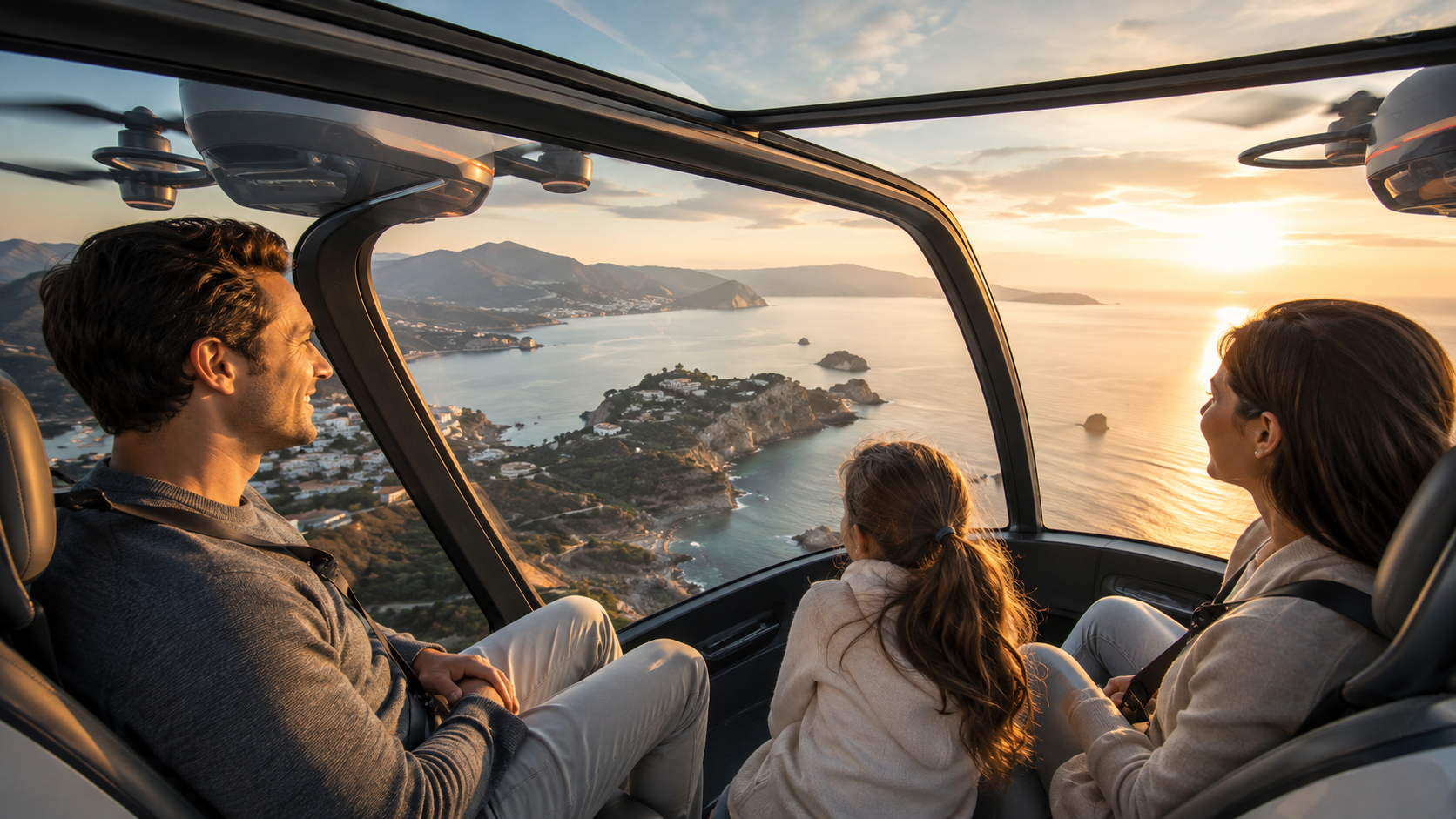
That means the eVTOL cabin should not be designed like a sports car cockpit. It should be designed like a compact premium lounge, aircraft cabin and elevator combined. The passenger experience will be about trust, calm, view, noise reduction, boarding ease, luggage handling, motion comfort, emergency clarity and psychological reassurance.
For automotive designers, this is a fascinating new design space. It sits somewhere between car, helicopter, business jet, tram, ride-hailing cabin and architectural pod.
But it is not personal transport in the emotional sense of a private car. It is personalized public transport, or premium shared mobility.
That distinction matters.
Why Joop Donkervoort’s instinct may still contain truth
Joop Donkervoort’s view that future personal transport may move into drones should not be dismissed. Visionary vehicle creators often sense direction before the infrastructure catches up.
There are reasons why aerial mobility remains compelling.
Roads are saturated. Building new roads is politically and spatially difficult. Tunnels and rail are expensive. Airports are poorly connected to many urban and suburban regions. Emergency services lose time in traffic. Islands, mountains and dispersed regions are poorly served by conventional transport.
Low-altitude electric aviation could solve some of these problems.
It could make airport transfers more predictable. It could connect regional business centers. It could replace some helicopter operations. It could provide rapid medical transport. It could serve remote communities. It could help disaster response. It could become part of premium mobility ecosystems around major cities.
So the idea is not foolish. What is foolish is imagining it as an unregulated aerial version of private motoring.
My prediction
My prediction is that eVTOLs will become real, but not in the way most people imagine.
By the late 2020s and early 2030s, we will likely see limited commercial air-taxi services in selected cities and regions: Dubai, Abu Dhabi, parts of the United States, China, perhaps Singapore, Korea, Japan and some European pilot corridors. These services will focus on airport links, sightseeing, premium mobility, special events and carefully selected high-value routes.
By the 2030s, eVTOLs may become a normal part of transport in certain locations, but still as a niche layer. They may replace some helicopter services, support emergency response and connect difficult routes where road or rail is inefficient.
By the 2040s, autonomy may allow more scalable services, but only if regulators, insurers, cities and the public accept the safety case. Even then, the system will be corridor-based, monitored and heavily controlled.
What I do not expect is mass private ownership of personal drones equivalent to today’s cars. The reasons are too strong: airspace complexity, weather, noise, energy use, landing-site limitations, certification, insurance, maintenance, public acceptance and the unacceptable consequences of failure.
In short: air taxis are plausible. Personal flying cars for everyone are not.
Conclusion: the future may fly, but it will not be free-for-all flying
The dream of personal flight is powerful because it promises liberation. No traffic jams. No roads. No congestion. No waiting. Just lift off and go.
But transport design is not only about desire. It is about systems.
The road network is already dangerous enough with vehicles operating on a flat plane. Moving personal transport into the air multiplies the consequences of error. The only responsible way to do it is through certified aircraft, managed airspace, controlled corridors, professional operations, high levels of automation and strict infrastructure.
That future may be useful, even exciting. It may produce beautiful new machines and new design opportunities. It may give automotive designers a new field somewhere between mobility, aviation and architecture. But it will not be the same kind of freedom that the private car once represented.
The most realistic future is not “everyone has a drone.”
It is this: some journeys, for some people, between some places, will move into the air.
For Car Design TV, the real question is not whether the flying car will finally arrive. It is whether designers, engineers, regulators and cities can resist turning a beautiful idea into low-altitude chaos.
The sky may become part of mobility. But only if it is treated less like a road — and more like aviation.