Volkswagen Mission Efficiency: Aerodynamics Take Control
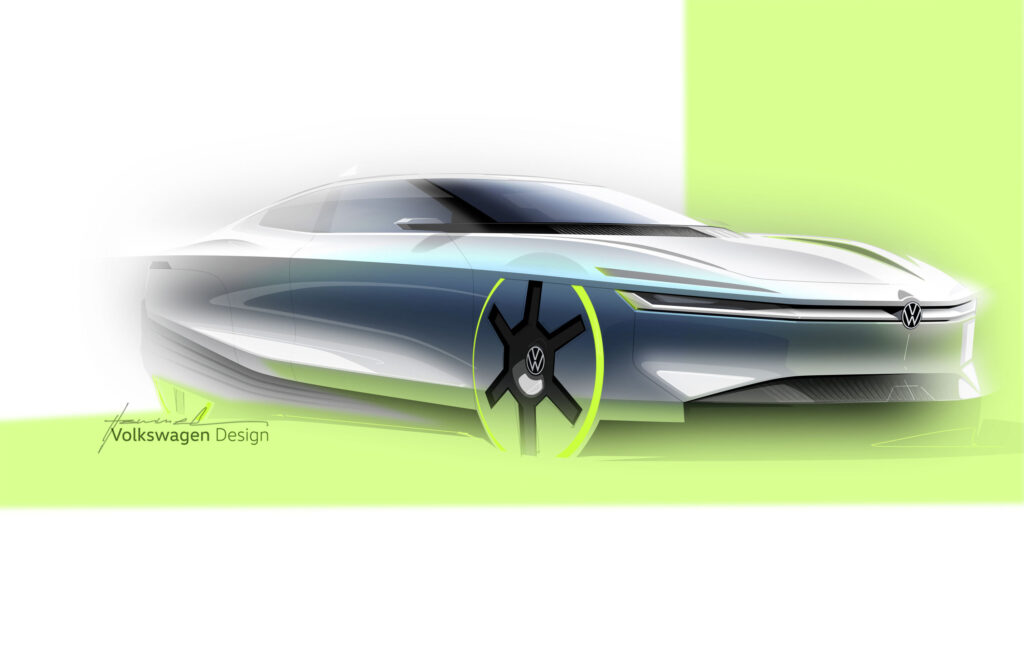

Volkswagen has presented the Mission Efficiency, a near-production electric prototype developed to show how far conventional EV technology can be pushed when aerodynamic efficiency becomes the central design objective. Rather than relying on a huge battery, extreme power output or exotic propulsion system, the car uses production-based components from Volkswagen’s new MEB+ generation and combines them with an exceptionally low-drag body, low rolling resistance and strict attention to weight.
The result is a car Volkswagen claims has established three efficiency records. Most striking is a drag coefficient of just Cd 0.158, which Volkswagen says is a record for a road-approved car. The Mission Efficiency also achieved an average consumption of 6.48 kWh/100 km under controlled ideal-driving conditions and recorded 6.89 kWh/100 km, excluding charging losses, during a documented long-distance road journey.
What makes the project particularly interesting from a design perspective is that Volkswagen has allowed aerodynamic requirements to influence almost every aspect of the vehicle’s proportions and surfacing.

Form Follows Airflow
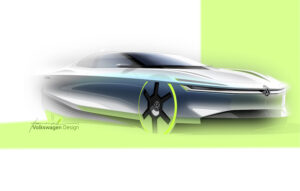
At 4,775 mm long and only 1,392 mm high, the Mission Efficiency has the long, low proportions needed to reduce frontal area and control the airflow over the body. Volkswagen quotes a frontal area of just 2.08 square metres, which is a critical factor because a good drag coefficient alone means relatively little if the car still presents a large cross-section to the air.
The body follows a clear teardrop philosophy, narrowing progressively towards the rear. The roofline remains low, the cabin is tightly packaged and the rear bodywork is extended sufficiently to allow the airflow to separate as cleanly as possible. Active cooling-air flaps, a fully enclosed underbody, flush door handles and frameless glazing all contribute to reducing turbulence.
The rear wheels are substantially covered, immediately recalling earlier Volkswagen efficiency projects, most notably the XL1. That comparison is intentional. Volkswagen’s chief designer Andreas Mindt has acknowledged that the Mission Efficiency carries some of the same design DNA.
The important difference is that the Mission Efficiency is not intended as a small-volume technological curiosity. Its underlying drivetrain is closely related to components intended for mainstream production.

The Wheel Areas Receive Serious Attention
One of the most revealing aspects of the project is how much engineering effort has gone into the wheels and wheel openings.
Volkswagen states that the wheels can account for between 25 and 30 percent of a vehicle’s aerodynamic resistance. On most production cars, however, wheels are treated increasingly as styling features. Large diameters, open spokes and exposed brakes have become visual status symbols, even though they can be aerodynamically inefficient.
Mission Efficiency takes almost the opposite approach.
The front wheel arches fit closely around the tyres in order to reduce turbulence inside the wheel housings. Volkswagen has also developed patented rim deflectors positioned on the inside of the wheels to prevent air from entering the rims and creating additional disturbance. On the outside, the wheel covers are deliberately flat and optimized for airflow.
The rear wheels go even further by being largely enclosed by the bodywork.
From a styling point of view, this is a significant decision because wheel design has become such an important part of the visual character of modern cars. Mission Efficiency demonstrates what happens when aerodynamic performance is given priority over the usual expectation that every wheel must be visually prominent.

Less Battery, More Efficiency
The drivetrain is surprisingly modest by current EV standards.
The car uses a 99 kW, 135 PS electric motor derived from the system being developed for the ID. Polo, together with a 54.9 kWh net battery. In a market where manufacturers increasingly rely on 80, 100 or even larger battery packs to achieve impressive range figures, Volkswagen has taken a very different approach.
During a documented 1,278.36-kilometre journey from Wolfsburg through Poland and the Czech Republic to Vienna, the Mission Efficiency recorded an average consumption of 6.89 kWh/100 km excluding charging losses. Including charging losses, the figure was 7.51 kWh/100 km.
The average speed during the journey was 67.72 km/h, while the car reached a maximum speed of 138 km/h. The battery was charged only once during the trip, and Volkswagen states that 164 kilometres of indicated range remained on arrival in Vienna.
These figures underline the central argument behind the project. Increasing range does not necessarily require increasing battery capacity. Reducing the amount of energy the vehicle needs in the first place can be equally effective.

Efficiency at Motorway Speeds
The aerodynamic advantages become increasingly important as speed rises.
Volkswagen states that above 80 km/h the Mission Efficiency consumes more than 30 percent less energy than a standard ID. Polo. At 140 km/h, the prototype reportedly requires approximately the same amount of energy as the ID. Polo needs at 100 km/h.
That comparison is perhaps more relevant than any theoretical maximum-range figure.
Electric drivetrains are already extremely efficient mechanically, but aerodynamic drag rises rapidly with speed. This is why many EVs perform impressively in urban environments yet lose range quickly during sustained motorway driving.
Mission Efficiency addresses this weakness directly through the shape of the car rather than attempting to compensate for it with additional battery capacity.

A Surprisingly Practical Package
Despite its extreme aerodynamic focus, Volkswagen has tried to retain a reasonable degree of practicality.
The Mission Efficiency is a 2+2 rather than a two-seat sports car and provides a 481-litre luggage compartment. Additional storage is located beneath the rear seats and within the body sides.
The rear seats are intended mainly for passengers up to approximately 1.60 metres tall, so the car cannot be considered a conventional four-seater. Even so, Volkswagen says the packaging was developed around the idea that a young family of four could theoretically use the car.
The structure combines production components from the ID. Polo with a self-supporting aluminium structure and elements made from carbon-fibre-reinforced polymer and aramid composite.
Some of those materials are clearly more exotic than would be expected in a mainstream Volkswagen, but the underlying drivetrain remains deliberately close to future production technology.

Rethinking the Braking System
Volkswagen has also investigated efficiency losses in components that receive far less attention from designers.
The Mission Efficiency uses the MacPherson front suspension and hydraulic front brakes from the ID. Polo, while the rear brakes are electromechanical.
The system reduces friction losses, eliminates some hydraulic lines and brake fluid, and allows more flexible brake-force distribution. Volkswagen says this arrangement also supports improved regenerative braking and can contribute to greater stability during cornering.
It is another example of the overall philosophy behind the car. No single technology is responsible for the result. Instead, relatively small efficiency improvements are accumulated throughout the entire vehicle.

Solar Power as Support, Not Propulsion
Photovoltaic cells are integrated into the roof and rear glass area, producing up to 370 watts.
Volkswagen is not presenting the Mission Efficiency as a solar-powered vehicle. Instead, the system supplies power to the car’s auxiliary electrical systems, reducing the amount of energy that has to come from the traction battery.
Depending on weather, season and location, Volkswagen estimates that the solar installation could contribute the equivalent of up to 30 kilometres of additional driving range per day.
The interior follows the same minimalist philosophy. Lightweight trim is used throughout, the conventional audio system has been replaced by a portable Bluetooth speaker, and a smartphone or tablet is intended to provide the main infotainment interface.
Some of these solutions are unlikely to appear unchanged in a normal production Volkswagen, but they illustrate how aggressively the project has been optimized.

A Different Direction for Electric Cars
Mission Efficiency is interesting because it questions the direction much of the electric-car industry has taken.
EVs have progressively become larger, heavier and more powerful. Wheel diameters have increased, tyres have become wider and battery packs have grown to compensate for the resulting energy consumption.
In many ways, electric vehicles have begun repeating the same development pattern that affected combustion-engine cars for decades.
Volkswagen’s prototype proposes a different approach.
Instead of asking how much battery capacity can be packaged underneath the floor, Mission Efficiency asks how little energy the car can be designed to consume.
That change in thinking has direct consequences for vehicle design. The low roof, tapering rear body, enclosed wheels, minimal cooling openings and controlled surface transitions are not decorative gestures. They exist because they reduce drag.
There will inevitably be compromises. Covered rear wheels remain unusual visually, the rear seating is limited and the extreme roof height will not appeal to every customer. But those compromises are also what make the project interesting.
Mission Efficiency demonstrates that aerodynamic design can still produce dramatic gains even when the propulsion system itself is relatively conventional.
For designers, the message is perhaps the most important part of the entire project.
The next major improvement in electric-car efficiency may not come from a revolutionary battery.
It may come from finally allowing the shape of the car to do more of the work.