From Software Defined to AI Defined: How Intelligence Will Reshape Automotive Design

For more than a century, the automobile was defined by hardware. Engines, transmissions, suspension layouts, body structures, and mechanical refinement determined the character of a vehicle. A Mercedes felt different from a BMW, a Jaguar, a Range Rover, a Porsche, or a Cadillac because its mechanical layout, steering geometry, ride tuning, engine response, seating position, and proportions were deliberately engineered to express a brand philosophy.
That world has not disappeared, but it is no longer enough.
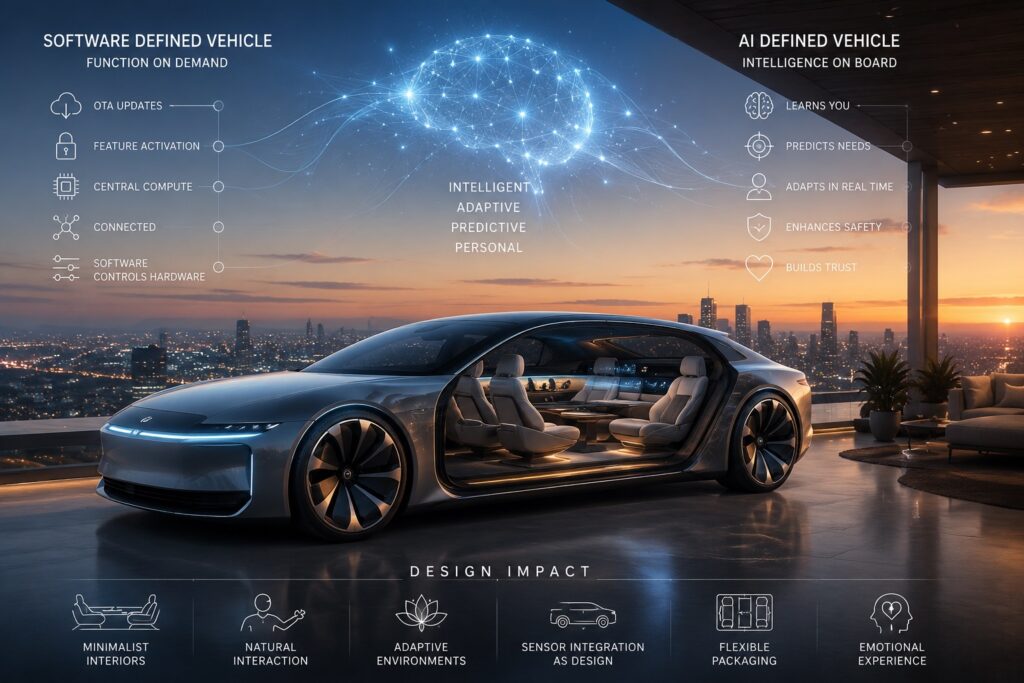
The car is now entering a new phase. First came the Software Defined Vehicle, or SDV. Now the industry is beginning to talk about the AI Defined Vehicle. These two terms are often used as if they mean the same thing, but they do not. The difference is crucial, especially for automotive designers.
A Software Defined Vehicle is a car whose functions can be changed, improved, activated, or updated through software. An AI Defined Vehicle goes further: it is a car whose behavior, interface, priorities, and even emotional character are increasingly shaped by artificial intelligence.
The SDV turns the car into a digital platform.
The AI Defined Vehicle turns the car into an intelligent companion.
That distinction will have enormous consequences for exterior design, interior design, user experience, brand identity, ergonomics, safety, and the role of the automotive designer.

The Software Defined Vehicle: The Car Becomes a Platform
A Software Defined Vehicle is not simply a car with a touchscreen. It is a vehicle whose key functions are controlled and improved through software rather than being permanently fixed at the moment of production.
In the traditional automobile, every function was tied closely to its own hardware. A feature such as adaptive cruise control, active suspension, lane keeping, heated seats, navigation, or battery management depended on a specific component, a dedicated control unit, and a fixed software package. Once the car left the factory, its capabilities were largely frozen.
The Software Defined Vehicle changes that logic.
Instead of being a collection of isolated mechanical and electronic systems, the car becomes an updatable digital platform. Over-the-air updates can improve infotainment, powertrain calibration, driver assistance, charging behavior, energy management, and sometimes even unlock new functions after purchase. Hyundai Motor Group, for example, announced a roadmap in which all of its vehicles would be equipped for over-the-air software updates by 2025, including Feature on Demand services. (Hyundai News)
This is why SDVs are often compared with smartphones. The hardware provides the platform, but the software defines much of the user experience. Bosch describes the Software Defined Vehicle as enabling connectivity, automation, personalization, and continuous optimization through over-the-air updates. (Bosch Mobility)
To make that possible, the industry is moving away from the old architecture of dozens, sometimes more than a hundred, separate ECUs distributed throughout the car. The new direction is toward centralized computing, domain controllers, zonal architectures, high-speed networks, cloud connectivity, and service-oriented software. Recent research on SDVs describes this shift as a move from distributed ECU systems toward domain-based, zonal, and centralized computing platforms. (arXiv)
For the customer, this means the car can improve over time. For the manufacturer, it means a longer relationship with the customer after the sale. For designers, it means that the physical object is no longer the complete product. The product now continues to evolve after delivery.
That is a fundamental design shift.

The AI Defined Vehicle: The Car Begins to Understand
An AI Defined Vehicle builds on the Software Defined Vehicle, but it changes the philosophy.
Software follows instructions.
AI interprets situations.
Software executes rules.
AI detects patterns.
Software waits for input.
AI can anticipate intent.
In an SDV, the car can be updated. In an AI Defined Vehicle, the car can increasingly adapt, learn, predict, personalize, and make contextual decisions.
A simple example makes the difference clear.
In a Software Defined Vehicle, the climate system might offer new features through an update: improved seat heating control, better defogging logic, or new air quality settings.
In an AI Defined Vehicle, the car may learn that one driver prefers the seat heater on cold mornings, the steering wheel heated below 7°C, a certain playlist during the commute, a calmer navigation voice in heavy traffic, and a different suspension setting on rural roads. Instead of asking the driver to select all of these settings manually, the vehicle begins to prepare the environment automatically.
That is not merely software control. That is behavioral intelligence.
The same applies to driving assistance. Traditional software-based driver assistance systems are largely rule-based. They respond to lane markings, objects, speed limits, and programmed thresholds. AI-based systems attempt to interpret context: what a cyclist might do, whether a pedestrian is about to step off the curb, whether another driver is behaving aggressively, or whether road conditions are changing before the vehicle physically reaches them.
NVIDIA, one of the major technology suppliers in this field, now explicitly uses the term “AI-defined vehicles” in relation to autonomous mobility and describes its vehicle platform as an end-to-end system spanning data preparation, model training, simulation, validation, and in-vehicle computing. (NVIDIA)
This is the deeper meaning of the AI Defined Vehicle. The intelligence is not just another feature. It becomes the organizing principle of the vehicle experience.

SDV vs AI Defined Vehicle: The Core Difference
The Software Defined Vehicle asks:
What can the vehicle do through software?
The AI Defined Vehicle asks:
What should the vehicle do in this specific situation?
That difference may sound subtle, but it changes everything.
A Software Defined Vehicle can offer a new interface after an update.
An AI Defined Vehicle can decide which interface is appropriate at that moment.
A Software Defined Vehicle can offer multiple drive modes.
An AI Defined Vehicle can adjust the vehicle continuously based on route, weather, road surface, driver behavior, and passenger comfort.
A Software Defined Vehicle can provide navigation.
An AI Defined Vehicle can understand whether the driver is late, tired, low on charge, avoiding highways, traveling with children, or likely to prefer a scenic route.
A Software Defined Vehicle can provide voice control.
An AI Defined Vehicle can behave like a natural conversational assistant.
A Software Defined Vehicle is programmable.
An AI Defined Vehicle is contextual.
That is the essential distinction.

Why This Matters for Automotive Design
For decades, automotive design has been concerned with the relationship between form, function, brand, ergonomics, engineering, safety, cost, manufacturing, and emotion. The designer shaped the visible expression of a machine.
With AI Defined Vehicles, designers will also need to shape the behavior of the machine.
This is a profound expansion of the designer’s role. It is no longer enough to ask, “What should the vehicle look like?” We must also ask:
How should the vehicle greet the occupant?
How should it communicate confidence?
When should it speak, and when should it remain silent?
How much should it anticipate?
How much control should it leave to the driver?
How does a luxury AI behave differently from a sports car AI, a family car AI, or a commercial vehicle AI?
What does brand identity mean when the vehicle has a digital personality?
In the past, a brand’s character was expressed through proportion, stance, surfacing, materials, switchgear, sound, and driving dynamics. In the AI era, brand character will also be expressed through timing, tone, restraint, responsiveness, visual behavior, conversational style, and the intelligence of the interface.
That moves automotive design into a new territory: the design of behavior.

Exterior Design: Sensors Become Part of the Aesthetic
Electrification already changed exterior design by altering proportions. Without a large combustion engine and transmission tunnel, designers gained new freedoms in overhangs, cabin position, wheelbase, floor height, and package layout.
AI will change exterior design in a different way.
An AI Defined Vehicle needs to perceive the world. That means cameras, radar, lidar, ultrasonic sensors, microphones, thermal imaging, and other sensing systems. These cannot simply be hidden as afterthoughts. They must be positioned where they can function correctly.
That creates a new design tension.
Designers want purity, sculpture, brand identity, and emotional appeal. Engineers need sensor fields of view, cleaning systems, thermal management, redundancy, and repairability. Regulators will demand safety and reliability. Customers will not accept ugly sensor bumps on premium vehicles.
The challenge will be to integrate intelligence visibly or invisibly in a way that strengthens the vehicle’s identity rather than compromising it.
Some brands may choose to hide sensors behind clean surfaces. Others may celebrate them as part of a technological expression. A luxury vehicle may treat sensor integration with architectural calm. A rugged off-road vehicle may express sensors as functional equipment. A performance car may make them part of an aerodynamic graphic. A robotaxi may use them as a trust signal, making its perception systems visible and understandable.
This becomes the new equivalent of grille design.
For more than a century, the front grille expressed engine cooling, power, brand identity, and status. In the AI Defined Vehicle, the “face” of the car may increasingly express perception, awareness, and intelligence.
The question is no longer only, “What does the car look like?”
It is also, “How does the car show that it sees?”

The Front End After the Grille
EV design has already created an identity problem. If there is no large radiator behind the grille, what should the front of the vehicle communicate? Many EVs have replaced grilles with blank panels, light bars, black masks, or decorative graphics. Some work beautifully. Others feel unresolved because they imitate a need that no longer exists.
AI may provide the next logic for the front end.
The front of the car becomes the sensing surface. It may contain cameras, radar, lidar, lighting, communication signals, and pedestrian-facing displays. This could lead to a new visual language where the vehicle’s face is not about intake, but about awareness.
A premium AI Defined Vehicle may have a calm, intelligent, almost architectural front. A sports AI vehicle may look intensely focused, with sensor graphics integrated into a low, sharp, aerodynamic face. A family vehicle may use friendly light signatures and softer forms to communicate safety. An autonomous shuttle may use external lighting or projected signals to communicate intent to pedestrians.
This could be one of the most important exterior design questions of the next decade.

Interior Design: From Cockpit to Intelligent Environment
The interior will be affected even more dramatically.
The traditional automotive interior is built around control. Steering wheel, pedals, instruments, switches, stalks, knobs, gear selector, climate panel, infotainment screen, window switches, mirror controls, drive-mode buttons, seat controls, and lighting controls all exist because the human must command the machine.
In the Software Defined Vehicle, many of those controls migrate into screens.
That has already created a backlash. Customers often dislike losing simple physical controls for functions they use every day. Touchscreens can be elegant, but they can also be distracting, slow, and frustrating. A car is not a phone. It moves. It vibrates. It demands attention. A driver cannot always look down, open a menu, and tap a small icon.
The AI Defined Vehicle could either solve this problem or make it worse.
If done badly, AI becomes another layer of complication: more menus, more notifications, more misunderstood voice commands, more unwanted automation.
If done well, AI allows the interior to become calmer.
The vehicle can reduce the need for constant manual input by understanding context. Climate, seat position, lighting, audio, navigation, charging, parking, and driver assistance can become more predictive and less intrusive. Instead of burying controls in menus, the vehicle can present the right control at the right time.
That is a major opportunity for interior designers.
The dashboard should no longer be seen as a fixed panel full of controls. It becomes an adaptive communication surface. Sometimes it displays rich information. Sometimes it disappears visually. Sometimes it reassures. Sometimes it warns. Sometimes it offers choices. Sometimes it does nothing, because doing nothing is the most elegant response.
This is where design restraint becomes crucial.
Luxury in an AI Defined Vehicle will not mean more screens. It may mean fewer interruptions.

The End of the Traditional HMI
For the last two decades, automotive HMI has largely meant screen design: menus, icons, touch targets, digital clusters, head-up displays, voice commands, and app ecosystems.
AI changes the definition of HMI.
The interface is no longer only what appears on a screen. The interface is the entire relationship between occupant and vehicle.
It includes:
Voice
Light
Sound
Gesture
Eye tracking
Seat movement
Climate behavior
Navigation suggestions
Warning timing
Autonomous driving confidence
Exterior communication
Cabin ambience
Personalization
Digital assistant personality
The best AI interface may be almost invisible. It may not look like technology at all. It may feel like the car simply understands.
This has deep implications for brand design.
A Rolls-Royce AI should not behave like a Tesla AI.
A Porsche AI should not behave like a Volvo AI.
A Defender AI should not behave like a Jaguar AI.
A family MPV AI should not behave like a luxury limousine AI.
Each brand will need to define not only a visual design language, but a behavioral design language.
How does the car interrupt?
How does it apologize?
How does it warn?
How does it suggest?
How does it celebrate?
How does it stay discreet?
These questions may sound unusual to traditional car designers, but they will become central.

Seating, Space, and the Changing Role of the Driver
Software Defined Vehicles do not necessarily change the basic seating layout. AI Defined Vehicles, especially when combined with higher levels of automated driving, eventually will.
If the vehicle can take over more driving tasks, the driver’s seat becomes less fixed in meaning. The cabin can shift between driving, relaxing, working, socializing, and entertainment.
This does not mean every future car becomes a lounge. That prediction has been exaggerated for years. Many people still enjoy driving, and many road environments will require human supervision for a long time.
But the balance will change.
In a Level 2 or Level 3 vehicle, the driver remains central but needs a different type of support: clarity, trust, monitoring, and smooth handover. In a Level 4 vehicle, the occupant may no longer need to face forward at all times. This changes the meaning of the instrument panel, windshield, side glass, roof, door openings, seat rotation, restraint systems, airbags, storage, lighting, and privacy.
Designers will need to think in modes:
Driving mode
Assisted driving mode
Autonomous mode
Work mode
Rest mode
Social mode
Entertainment mode
Arrival mode
The AI Defined Vehicle becomes a space that changes its behavior according to use.
That makes automotive interior design closer to architecture, furniture design, aviation, hospitality, and interaction design. The cabin becomes a room that moves, senses, predicts, and responds.

Personalization Beyond Memory Settings
Traditional personalization is primitive. A car remembers a seat position, mirror setting, radio station, and perhaps a favorite climate temperature.
AI personalization is far deeper.
The car may learn the difference between weekday commuting, weekend driving, long-distance travel, school pickup, business arrival, airport transfer, or a relaxed evening drive. It may understand different occupants and adapt accordingly.
For example:
When the owner drives alone, the cabin may be focused, quiet, and performance-oriented.
When grandchildren are in the back, the car may soften acceleration, adjust rear climate, offer entertainment, and avoid aggressive navigation choices.
When the owner is on the way to a business meeting, the car may prioritize punctuality, phone integration, and calm lighting.
When the driver is tired, the vehicle may reduce cognitive load.
This is where the AI Defined Vehicle becomes emotionally significant. It is not only performing tasks. It is shaping the occupant’s state of mind.
For designers, this means the cabin is no longer one fixed emotional expression. It must support a range of moods while still feeling coherent as a brand.
That is difficult. It requires discipline. A vehicle that can be anything often becomes nothing. The strongest brands will define clear boundaries: the AI may adapt, but it must always adapt in a way that feels like that brand.

AI and the Design Process Itself
AI will not only change the vehicle. It will change how vehicles are designed.
Generative AI is already being explored across automotive design, manufacturing, simulation, and in-vehicle experience. Research on generative AI in automotive points to applications in vehicle design, manufacturing, autonomous driving, predictive maintenance, and personalized in-vehicle user experience, while also warning about challenges such as bias, robustness, intellectual property, safety, and computational demands. (arXiv)
AI can assist with:
Concept ideation
Package studies
Ergonomic simulations
Aerodynamic exploration
Material proposals
Color and trim variations
Lighting scenarios
User interface flows
Synthetic driving environments
Manufacturing optimization
Customer personalization
Marketing imagery
Design research
Competitive analysis
This does not mean AI replaces designers. In fact, the opposite may be true. As AI generates more options, the value of judgment increases.
A designer’s role becomes less about producing one sketch after another and more about selecting, directing, editing, refining, and giving meaning to possibilities. The designer becomes a curator of intent.
AI can produce thousands of forms. But it does not automatically know which one has dignity, tension, restraint, elegance, cultural relevance, or brand truth. It can imitate. It can combine. It can optimize. But the designer must still decide what matters.
The risk is that AI makes everything look generically impressive. The opportunity is that designers can use AI to explore faster, test more intelligently, and spend more time on the emotional and strategic quality of the design.
The best future design studios will not be AI-driven. They will be human-led and AI-amplified.
The Danger of Over-Automation
There is an important caution here. AI is powerful, but it is not magic. Automotive design and engineering involve judgment, experience, tacit knowledge, safety responsibility, and countless trade-offs.
The industry should be careful not to confuse AI capability with automotive wisdom.
Recent reporting about Ford rehiring veteran engineers after AI-led processes missed important quality issues is a useful reminder that institutional knowledge and human experience remain essential. The lesson is not that AI is useless; it is that AI without experienced human guidance can miss the subtleties that seasoned engineers and designers recognize instinctively. (The Times)
This applies directly to design.
AI may generate a beautiful interior image, but will it understand ingress and egress for a 95th percentile male with limited hip mobility? Will it understand glare, airbag deployment, repair cost, child-seat access, elderly users, manufacturing tolerance, regulatory zones, emotional durability, and long-term brand equity?
Only if the system is trained, constrained, and guided properly.
The AI Defined Vehicle must not become the technology-defined vehicle. The human being must remain central.
Implications for Different Vehicle Types
The impact of AI will differ by segment.
Luxury Cars
Luxury vehicles may benefit most from invisible intelligence. True luxury is not complexity. It is effortlessness. An AI luxury vehicle should not constantly show off. It should anticipate quietly, reduce friction, and create a sense of calm mastery.
The future luxury cabin may have fewer visible controls, richer materials, warmer lighting, more personalized comfort, and a more discreet digital layer.
Sports Cars
For sports cars, AI must be handled carefully. Enthusiasts do not want the machine to remove the driver from the experience. Here, AI should enhance skill, not replace it.
It could help with adaptive chassis control, predictive traction, coaching, track analysis, energy deployment, and safety margins. But the emotional connection must remain direct.
A sports car AI should feel like an expert race engineer, not a nanny.
Family Vehicles
In family cars, AI can focus on safety, convenience, comfort, and reduced stress. The vehicle can recognize occupants, manage child comfort, suggest safer routes, monitor fatigue, assist parking, and simplify daily routines.
The design opportunity is to make intelligence feel trustworthy and friendly without becoming childish.
Commercial Vehicles
In vans, trucks, shuttles, and chauffeur-driven vehicles, AI may transform productivity. Routing, fleet management, predictive maintenance, loading optimization, driver monitoring, passenger comfort, and autonomous operation can all become part of the design brief.
For commercial design, intelligence becomes part of efficiency and profitability.
Ultra-Luxury and Bespoke Vehicles
For ultra-luxury vehicles, such as chauffeur-driven concepts connected to yacht, aviation, or private residence design, AI opens a fascinating possibility: the vehicle becomes part of a larger lifestyle ecosystem.
The car knows the yacht itinerary, the residence climate preferences, the owner’s calendar, the desired privacy level, the preferred lighting mood, and the arrival protocol. In this world, automotive design merges with architecture, hospitality, and personal service.
The vehicle is no longer just transportation. It becomes a moving private environment.
What Designers Must Learn Next
The next generation of automotive designers will still need to understand proportion, stance, sculpture, surfacing, package, ergonomics, manufacturing, and brand identity. Those fundamentals remain essential.
But they will also need new literacy in:
Artificial intelligence
User experience design
Behavioral design
Human-machine interaction
Sensor integration
Digital ecosystems
Service design
Ethics
Data privacy
Autonomous driving behavior
Adaptive interiors
Conversational interfaces
Simulation and synthetic environments
The car designer of the future will not simply draw the vehicle. They will help define how the vehicle behaves.
That does not diminish the role of design. It elevates it.
Because as vehicles become more intelligent, the question of how they should behave becomes a design question, not just an engineering question.
Conclusion: From Object to Intelligence
The Software Defined Vehicle is already changing the car industry. It turns the vehicle into a platform that can evolve through software, over-the-air updates, connected services, and centralized electronic architecture.
But the AI Defined Vehicle represents a deeper transformation.
It changes the car from an object that obeys commands into an environment that understands context. It changes the interface from a set of controls into a relationship. It changes brand identity from a visual and mechanical signature into a behavioral personality. It changes the designer’s task from shaping form to shaping experience, intelligence, and trust.
For automotive designers, this may be more profound than the shift from combustion to electric propulsion. Electrification changed the package. AI changes the relationship between human and vehicle.
The most important cars of the future will not simply be faster, cleaner, more connected, or more automated. They will be more aware. More adaptive. More personal. More emotionally intelligent.
The challenge is to make that intelligence beautiful.
That is where design becomes essential again.