China’s Multi-Brand EV Explosion: Strategy, Badge Engineering, or Brand Inflation?
Why Chinese carmakers are creating so many new brands — and why Europe should pay close attention
The global car industry is entering a strange new phase.
For most of the 20th century, car brands were built slowly. They were shaped by founders, racing history, national identity, engineering traditions, design language, dealer networks, advertising memory, owner communities, and decades of customer experience. A car brand was not just a logo. It was accumulated trust.
Today, especially in China, new car brands can appear almost overnight.
A parent company develops a platform, battery system, electric drivetrain, software stack, supply chain, and manufacturing base. Then it creates multiple brands or sub-brands to target different customers: young urban buyers, premium EV users, lifestyle SUV customers, luxury MPV clients, European export markets, technology enthusiasts, fleet operators, and price-sensitive families.
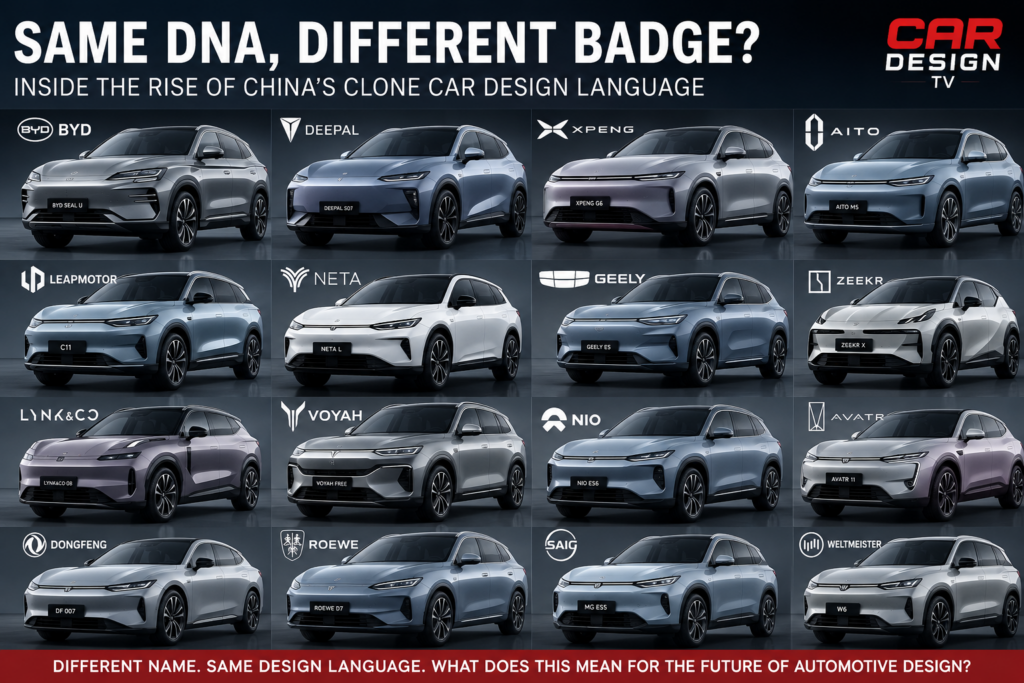
The result is a rapidly multiplying landscape of names: BYD, Denza, Fangchengbao, Yangwang, Geely, Zeekr, Lynk & Co, Galaxy, Volvo, Polestar, Smart, Lotus, Chery, Omoda, Jaecoo, Exeed, Jetour, iCar, SAIC, MG, IM, Roewe, Maxus, Wuling, Baojun, Great Wall, Haval, Wey, Ora, Tank, Xpeng, NIO, Onvo, Firefly, Leapmotor, Aito, Avatr, Deepal, Luxeed, and many more.
Some of these brands are serious and well defined. Some are technically capable but emotionally vague. Some are built around real customer insight. Others feel like marketing segmentation searching for a soul.
This trend raises a major question for car design and brand strategy:
Can an automotive brand still mean something if it is created faster than the customer can understand it?
The Volkswagen comparison
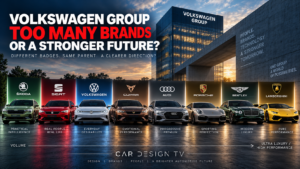
In an earlier Car Design TV article, we looked at Volkswagen Group’s multi-brand strategy. Volkswagen, Škoda, SEAT/CUPRA, and Audi often share platforms and technology, yet they are positioned differently. Škoda is practical and rational. CUPRA is emotional and sporty. Audi is premium and technical. Volkswagen is supposed to be the intelligent mainstream center.
That system is far more sophisticated than old Detroit badge engineering. It is not simply a matter of changing grilles and badges. Platform sharing allows enormous efficiency, but each brand must still have a clear role.
The danger for Volkswagen is that its own derivatives can become more emotionally interesting than Volkswagen itself. If Škoda is more useful, CUPRA more exciting, and Audi more premium, Volkswagen risks becoming the neutral default.
The Chinese situation is similar, but faster and more extreme.
Chinese carmakers are not just sharing platforms across established brands. They are often creating entirely new brand identities at extraordinary speed, sometimes before the customer has any emotional relationship with the parent company. In Europe, many of these names arrive with no history, no cultural memory, no owner base, no racing mythology, and no clear reason to be trusted beyond price, technology, and warranty.
That can work in the short term.
But can it create durable brands?
Why China is creating so many brands
The Chinese auto market is brutally competitive. It is large, fast-moving, price-sensitive, technology-driven, and increasingly saturated. New models appear quickly. Software expectations are high. EV and plug-in hybrid technology develops rapidly. Customers are willing to consider new brands if the product, price, digital experience, and specification are attractive.
In that environment, creating a new brand can be a strategic shortcut.
A manufacturer may decide that its existing name is too mainstream, too old-fashioned, too cheap, too regional, too commercial, or too weak for a new product type. Instead of slowly repositioning the original brand, it creates a new one.
This gives the company freedom.
A new brand can have:
- a different price level;
- a different showroom experience;
- a different design language;
- a different tone of voice;
- a different software interface;
- a different target age group;
- a different export strategy;
- a different perception of premium or technology.
This is attractive because EV platforms are modular. Once the expensive foundation exists — battery, motors, electronic architecture, safety structure, software, manufacturing system — it can support many models. A new top hat, interior theme, lighting signature, and brand story can create another product line quickly.
In theory, this is efficient.
In practice, it can also lead to brand inflation.
Brand inflation: when every platform needs five personalities
Brand inflation happens when companies create more brands than customers can meaningfully understand.
A platform becomes a technical base. Then marketing asks: who else can we target with it? Younger buyers? Premium buyers? Outdoor buyers? Female buyers? Urban buyers? Export buyers? Tech buyers? Luxury buyers? Lifestyle buyers?
Each group gets a new badge.
This may make sense in a PowerPoint presentation, but customers do not live in PowerPoint. They live in the real market, where they must remember names, understand trust, compare resale value, find service, evaluate dealer support, and decide whether a brand will still exist in five years.
That is the fundamental weakness of rapid brand creation.
A name can be launched quickly. Trust cannot.
The classic European brand shortcut
Some Chinese companies have solved the trust problem by acquiring or using established European brands.
The most obvious example is MG. To many European consumers, MG still carries some British memory, even though the current MG Motor is owned by SAIC Motor. This gives SAIC something extremely valuable: a familiar badge with emotional residue. The current cars may be Chinese-developed and globally positioned, but the MG name lowers the psychological barrier for buyers.
Geely took a different route. It acquired Volvo Cars and later built a complex ecosystem involving Volvo, Polestar, Lotus, Smart, Zeekr, Lynk & Co, and other brands. This gives Geely both Chinese scale and European legitimacy. Volvo provides safety and Scandinavian trust. Lotus provides performance mythology. Smart provides urban recognition. Polestar provides minimalist EV credibility. Zeekr provides premium Chinese EV technology.
This is not simply badge engineering. It is brand architecture by acquisition and creation.
But it is also complicated.
How many brands can one group operate before the customer becomes confused?
Geely: the most sophisticated Chinese brand portfolio
Geely is perhaps the best example of a Chinese group that has moved beyond “Chinese carmaker” into global brand portfolio management.
Its ecosystem includes Geely Auto, Lynk & Co, Zeekr, Volvo Cars, Polestar, Lotus, Smart, Proton, LEVC, Farizon, Radar/Riddara and others. Zeekr Group describes itself as a premium new energy vehicle group from Geely Holding, combining Zeekr and Lynk & Co and claiming more than 1.8 million users worldwide. This shows how rapidly Chinese groups are trying to build brand clusters rather than single-brand companies.
The strategy has logic.
Volvo is safety and premium family trust.
Polestar is design-led electric minimalism.
Lotus is performance and lightweight heritage, even if that meaning is now being stretched into electric SUVs and sedans.
Smart is urban mobility with Mercedes-Benz legacy.
Zeekr is high-tech premium Chinese EV.
Lynk & Co is younger, connected, subscription-oriented, and lifestyle-focused.
The issue is not whether Geely has brands. The issue is whether every brand can remain distinct as technology, platforms, screens, motors, batteries, and architectures converge.
If customers begin to feel that a Zeekr, Polestar, Lynk & Co, Smart, and Volvo are different costumes over the same corporate intelligence, then the brands must work harder emotionally.
Geely’s advantage is that several of its brands already have real identity. Volvo and Lotus are not invented overnight. Polestar has design credibility. Smart has recognition. Zeekr has built a strong technology image in China.
But the long-term challenge remains: differentiation must be experienced, not merely described.
Chery: the export-brand machine
Chery is one of the most interesting examples because it has aggressively created and expanded multiple brands aimed at different audiences and markets.
Chery International presents Chery as a global Chinese car brand with over 15 million units sold worldwide. Under the broader Chery umbrella are names such as Omoda, Jaecoo, Exeed, Jetour, iCar and others. Omoda and Jaecoo in particular are being pushed internationally, including in Europe.
The logic is clear.
Chery as a name may not carry much emotional weight in Europe. It may also still be associated by some with earlier generations of Chinese cars that were not yet globally competitive. Omoda and Jaecoo give Chery a fresh start. They sound international, somewhat abstract, and unburdened by old perceptions.
Omoda can be positioned as stylish, urban, and youthful.
Jaecoo can be positioned as more rugged, premium, SUV-oriented, or outdoorsy.
Exeed can be positioned higher.
Jetour can address family and travel markets.
iCar can target EV and younger tech customers.
From a business perspective, this is clever. From a brand perspective, it is risky.
The customer may ask: Who actually makes this car? Is Omoda the brand? Is Chery the company? Is Jaecoo related? Is Exeed above them? Is this a stable brand or a temporary export label? Will parts and service be available in eight years? What happens to resale value if the brand strategy changes?
These are not minor questions. In Europe, brand trust is slow to build and quick to lose.
SAIC and MG: the power of an inherited badge
SAIC’s strategy shows why an old European name can be so useful.
MG has become one of the most successful Chinese-owned car brands in Europe precisely because it does not arrive as an unknown Chinese acronym. It arrives as MG: short, familiar, pronounceable, and historically connected to British sports cars, even if current MG products are mostly mainstream EVs and crossovers rather than traditional roadsters.
SAIC Motor says its self-owned brands include Roewe, MG, IM, Maxus, Wuling, and Baojun, and reported that sales of those self-owned brands reached 2.928 million units in 2025. MG’s European site identifies SAIC Motor as MG’s parent company and lists related SAIC companies such as Roewe and Maxus.
MG’s current success proves that a historic badge can accelerate acceptance. But it also raises a question: what happens when the badge’s history and the product reality diverge too far?
MG once meant small British sports cars. Today, for many European buyers, it increasingly means affordable Chinese-built EVs and SUVs. That may be commercially successful, but it changes the brand. The old memory becomes a bridge to a new identity.
If the new identity is consistent, MG can survive. If it becomes only a convenient label, the heritage will eventually be exhausted.
BYD: less brand chaos, more vertical power
BYD is different.
BYD has created sub-brands and premium lines, including Denza, Fangchengbao and Yangwang, but its core global strategy is still strongly tied to the BYD name itself. That gives it clarity. BYD means battery expertise, vertical integration, cost control, and fast product expansion.
This is a major advantage.
While some Chinese companies create many names to cover many audiences, BYD has been building one central global reputation: a technology and manufacturing powerhouse. Its sub-brands can then extend upward or sideways without necessarily weakening the parent name.
For Europe, that may be easier to understand. A customer may not know every BYD sub-brand, but they increasingly know BYD.
That matters because in the EV age, battery trust is central. If BYD becomes associated with battery competence, the brand has a real foundation beyond styling and price.
Great Wall: segmentation by character
Great Wall Motor has used a multi-brand approach with Haval, Wey, Ora, Tank and others. This is a more character-based structure.
Haval is SUV mainstream.
Wey is more premium.
Ora is electric and more playful.
Tank is rugged off-road.
Great Wall itself is corporate parent.
This kind of segmentation can work because each brand has a relatively clear product-world. The danger is again international recognition. In China, these distinctions may be clearer. In Europe, they arrive as unfamiliar names that require explanation.
The more a salesperson has to explain the corporate family tree, the more fragile the brand is.
NIO, Onvo, Firefly: one premium brand, then downward expansion
NIO began with a relatively clear premium EV identity: technology, battery swapping, user community, high-end design, and a strong digital ecosystem. That clarity helped it stand out.
But NIO has also created Onvo and Firefly to address more affordable or different segments. Strategically, this is understandable. A premium brand alone may not create enough volume. But this is the classic danger of brand stretching in reverse.
If NIO is premium, what is Onvo?
If Firefly is smaller and cheaper, does it support or dilute the NIO ecosystem?
Are these separate brands or feeder brands?
Will customers understand the hierarchy?
This is very similar to the Volkswagen problem, but in a younger company. Volkswagen has to protect an old brand from vague middle positioning. NIO has to prevent a new premium identity from being diluted before it has fully matured globally.
The problem with made-up names
Many Chinese EV brands use invented or semi-international names. Some are easy to pronounce. Some are awkward. Some sound technological. Some sound like consumer-electronics brands. Some feel like they were chosen for trademark availability rather than emotional depth.
This is not unique to China. Western companies also create strange names. But the scale and speed in China make the issue more visible.
A made-up name has advantages:
- it is legally protectable;
- it can be used globally;
- it avoids old associations;
- it can be positioned freely;
- it can sound modern or digital.
But it also has weaknesses:
- no heritage;
- no emotional memory;
- no trust;
- no cultural meaning;
- no pronunciation confidence;
- no resale familiarity;
- no established dealer/service expectation.
That means the product has to do more work. The design has to do more work. The warranty has to do more work. The price has to do more work. The technology has to do more work.
A new brand can succeed, but it must prove itself quickly and consistently.
Design language as instant identity
Because many new Chinese brands lack history, design becomes their fastest form of identity.
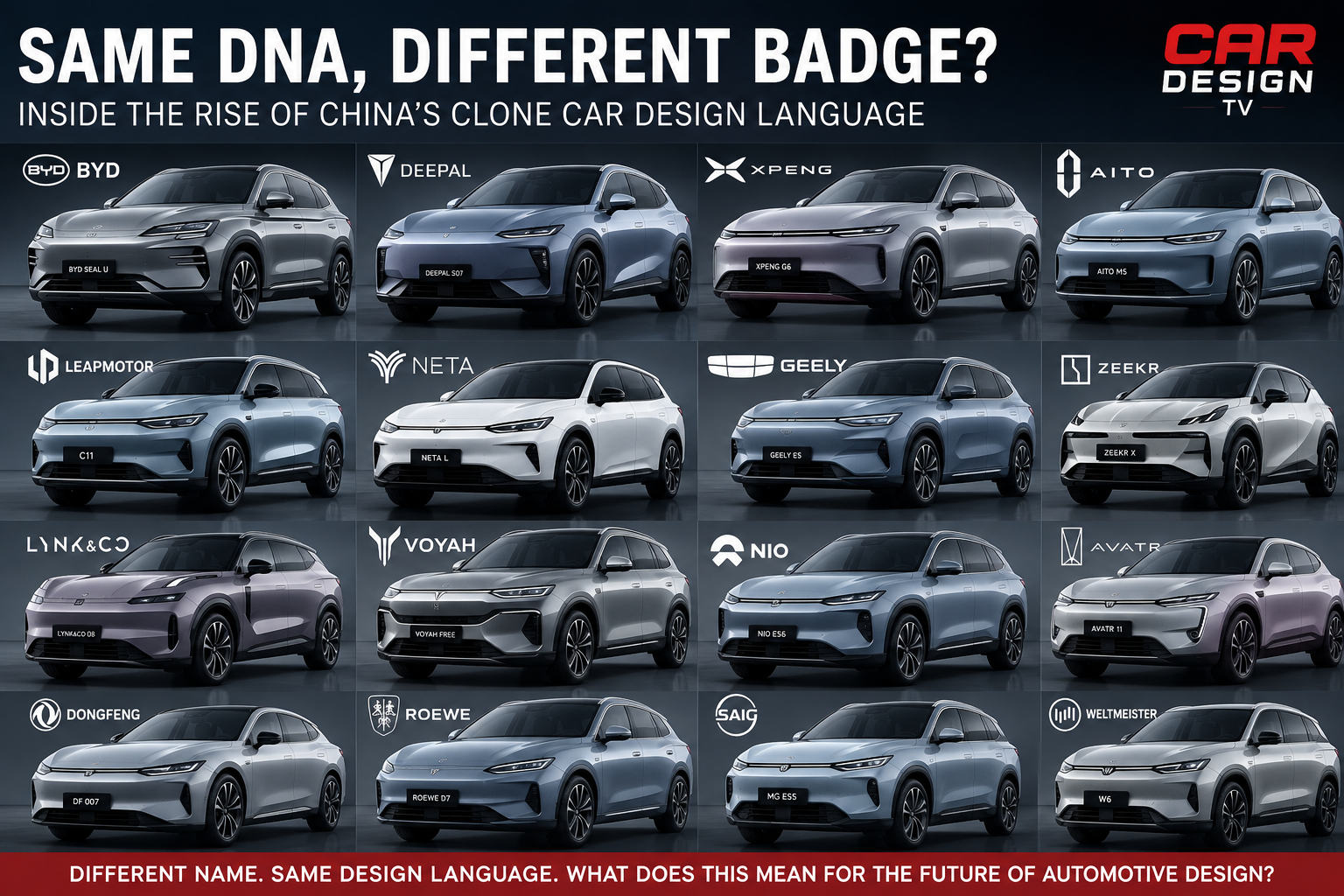
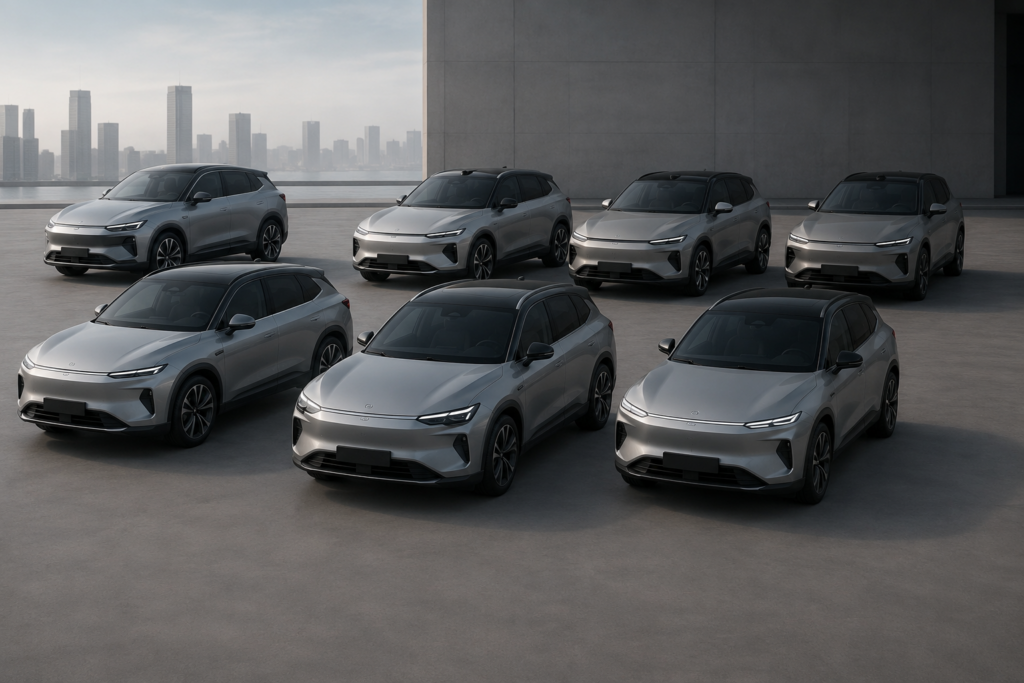
This explains why so many Chinese EVs are visually assertive. Light signatures, full-width lamps, floating roofs, flush handles, large screens, dramatic interiors, lounge-like rear seats, animated lighting, and high-tech surfaces are used to communicate modernity quickly.
The problem is that many brands use similar ingredients.
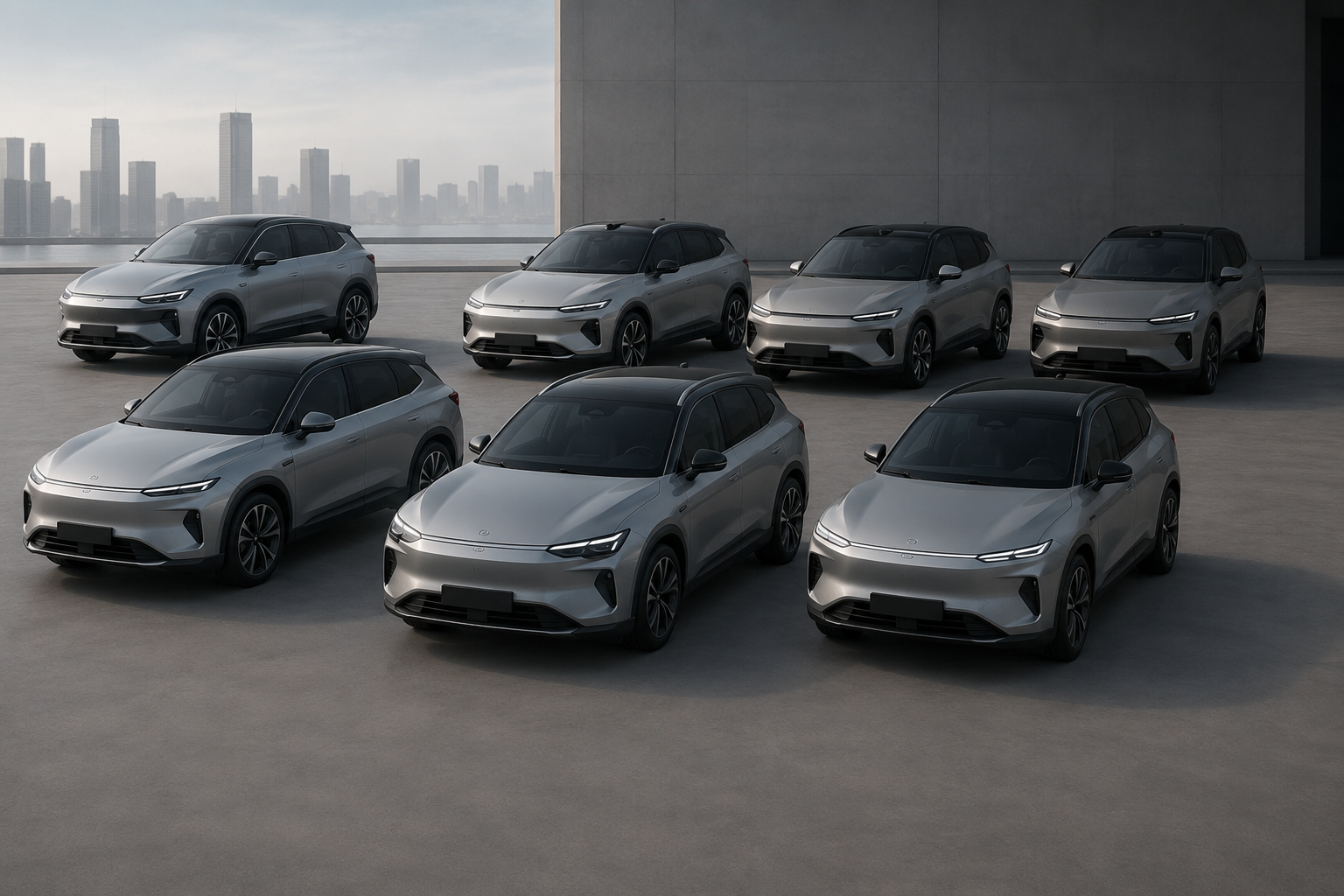
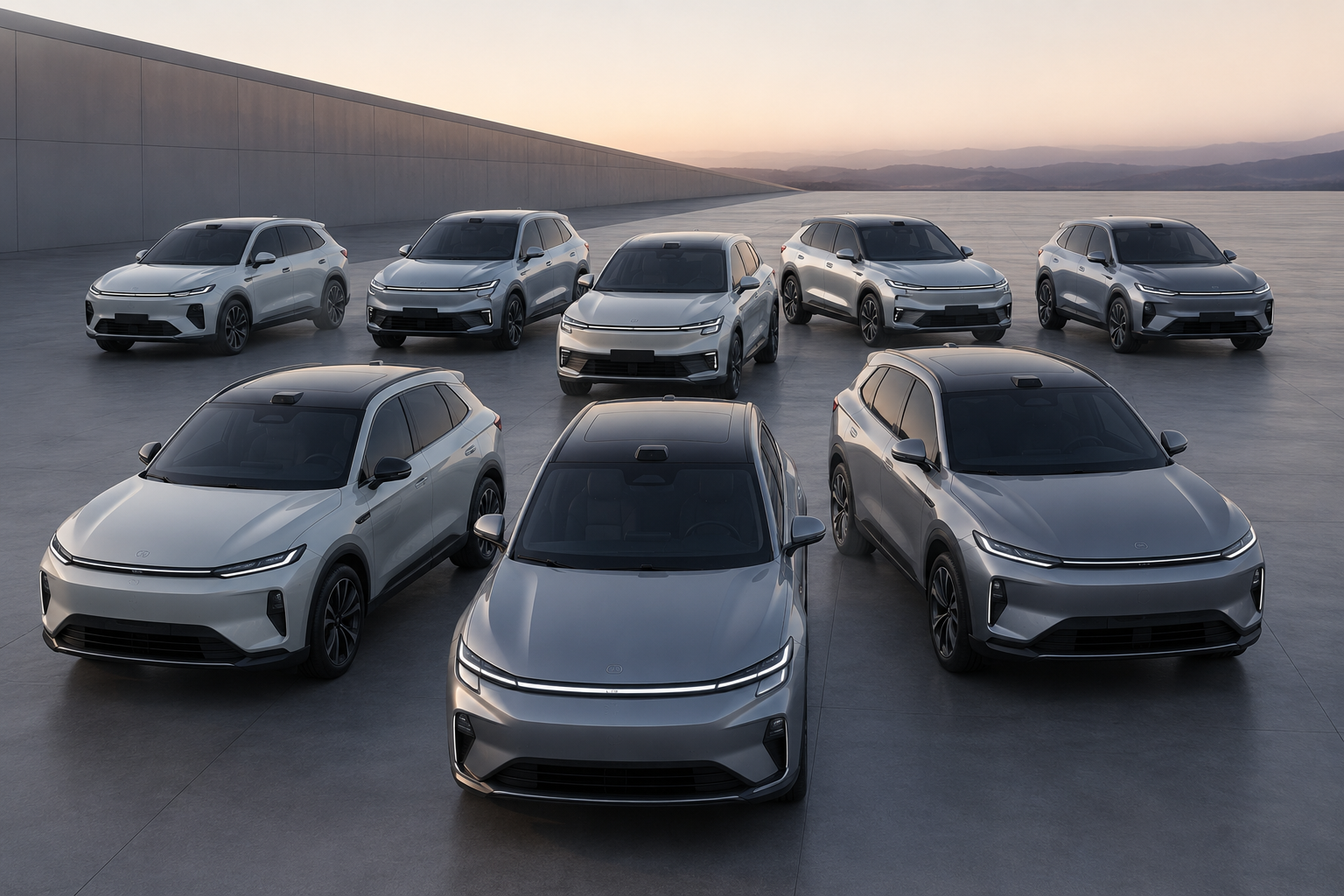
If every brand has a full-width light bar, a large screen, flush door handles, a glass roof, ambient lighting, a minimal grille, and an “intelligent cockpit,” then none of those features create identity anymore.
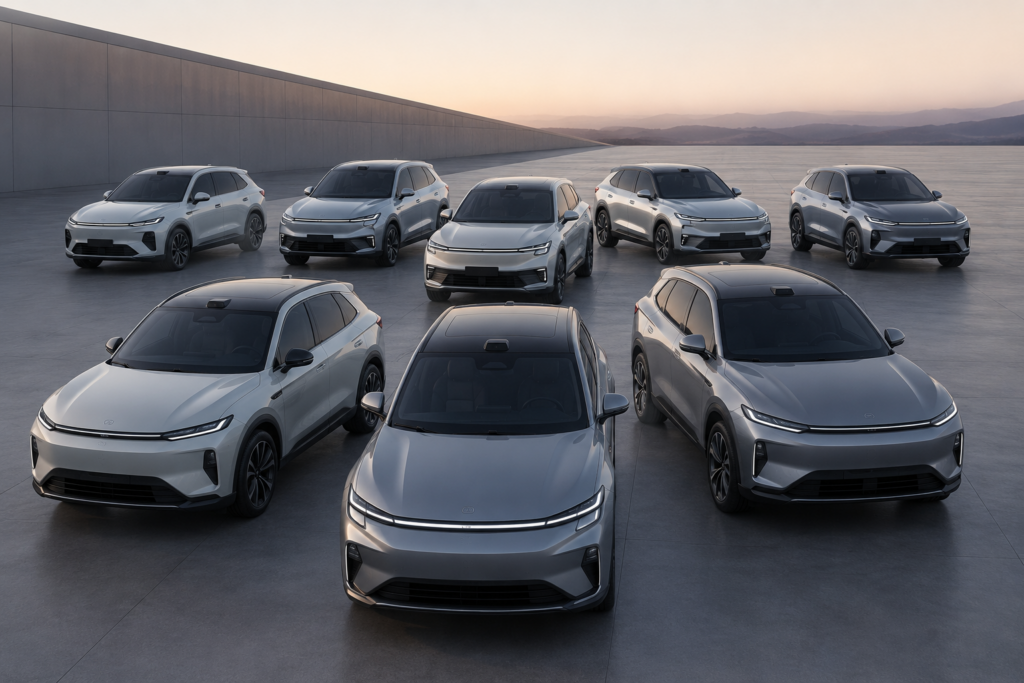
The risk is a new form of global EV sameness.
Not old badge engineering, where cars shared metal and changed badges.
But digital-era sameness, where cars share the same visual grammar of EV modernity.
The customer sees different logos, but the emotional experience feels strangely similar.
Platform sharing is not the enemy
It is important to be fair. Platform sharing itself is not bad.
A modern car is too expensive to develop in isolation. Safety, batteries, software, motors, electronics, ADAS, thermal management, crash performance, homologation, manufacturing, and supply chain all demand scale. Shared platforms are essential.
Volkswagen proved this. Toyota proved this. Stellantis relies on it. Hyundai-Kia does it. Renault-Nissan-Mitsubishi does it. Mercedes, BMW, GM, Ford, and almost every major manufacturer do it.
Chinese companies are simply doing it at EV speed.
The issue is not shared platforms.
The issue is whether the brands built on those platforms have genuine purpose.
A platform can support many brands if the customer experiences a real difference in design, use, quality, service, price, emotion, and culture. But if the difference is only lamps, grille treatment, software skin, and marketing language, then the customer eventually sees through it.
Europe’s challenge: too many new names at once
For European consumers, the Chinese brand explosion can be overwhelming.
A customer may already understand Volkswagen, Audi, BMW, Mercedes, Renault, Peugeot, Citroën, Volvo, Toyota, Hyundai, Kia, Ford, Opel, Fiat, Dacia, Nissan, Honda, Mazda, Tesla, and others. Now add BYD, NIO, Xpeng, Zeekr, Lynk & Co, Omoda, Jaecoo, Hongqi, Leapmotor, Aiways, Seres, Voyah, Dongfeng, Maxus, MG, Smart, Polestar, Lotus, Denza, and more.
Some of these are Chinese-owned European heritage brands.
Some are new Chinese brands.
Some are joint ventures.
Some are premium.
Some are value.
Some are direct-sales.
Some use traditional dealers.
Some may manufacture locally in Europe.
Some may disappear.
This creates both opportunity and uncertainty.
The opportunity is more choice, more technology, faster EV adoption, and pressure on European brands to improve.
The uncertainty is trust.
European customers may ask:
- Will this brand still exist in ten years?
- Who services it?
- What is the residual value?
- Is the software supported long term?
- Are parts available?
- Is the safety record proven?
- Is the battery warranty meaningful?
- Is the brand serious or experimental?
- Is this a real car company or a temporary export push?
These questions matter especially for private buyers, fleet managers, leasing companies, and insurers.
The dealer and importer problem
A new car brand does not succeed only because the car is good. It needs distribution, service, parts, training, warranty handling, customer support, finance, leasing, and residual-value confidence.
This is where some Chinese brands may struggle.
Launching a car is easier than supporting a car for 12 years.
European brands have old dealer networks, parts systems, technical training, and customer familiarity. They also have problems, but the infrastructure exists. Chinese brands must either build that infrastructure, partner with existing dealer groups, or use direct-sales models with mobile service and centralized support.
Some will do this well. Others may underestimate the difficulty.
The more brands a Chinese group launches, the more complex this becomes. It is one thing to support one new brand. It is another to support four or five related but separately positioned brands with different customer expectations.
Brand multiplication can overload the retail system.
The design consequence: shallow identities
From a car design perspective, the most interesting danger is shallow identity.
A traditional brand identity develops through repeated design decisions over time. You learn what a Volvo face means, what a Porsche side view means, what a Mercedes interior should feel like, what a Jeep stance communicates, what a Mini roof graphic does, what a Range Rover volume expresses.
New Chinese brands often try to compress this process.
They launch with a brand manifesto, a logo, a lighting signature, a design language, a digital cockpit, and a few lifestyle images. But they do not yet have the weight of repetition. The customer has not seen the idea mature across generations.
This can produce design that is visually competent but emotionally temporary.
The car may look modern today but lack the deeper brand grammar needed to remain meaningful tomorrow.
That is why some Chinese vehicles can be impressive at first glance but hard to remember afterward. The surfaces are good. The technology is good. The interior is impressive. But the brand story has not yet settled.
The opposite risk: copying premium codes too closely
Some Chinese brands use design codes that feel very close to established premium brands: European proportions, Germanic graphics, Scandinavian minimalism, British luxury cues, Tesla-like smoothness, or Porsche-like stance.
This is understandable. New brands borrow from known visual languages to signal credibility.
But if the borrowed codes are too obvious, the brand cannot become authentic. It remains derivative.
The strongest Chinese brands will be the ones that stop asking, “How do we look premium to Europeans?” and start asking, “What is our own design worldview?”
That is the point at which Chinese car design will become truly mature globally.
What could happen next?
Several outcomes are likely.
1. Consolidation
Not all of these brands will survive. China already has too many carmakers and too many EV brands. Price wars and intense domestic competition are forcing companies to seek profit abroad, but international expansion is expensive. Some brands will merge, disappear, be absorbed, or become regional.
The next decade will likely reduce the number of active global Chinese car brands.
2. Stronger corporate-brand structures
Companies may begin emphasizing the parent group more clearly. Instead of hiding behind many names, they may use a structure similar to Toyota/Lexus, Hyundai/Genesis/Kia, or Volkswagen Group’s brand groups. Customers need to know who stands behind the vehicle.
Trust may require transparency.
3. Acquired European brands will become more valuable
MG, Volvo, Lotus, and Smart show the advantage of known names. Other Chinese companies may seek partnerships, licensing, acquisitions, or production alliances with European brands and factories. This can provide legitimacy, distribution, and emotional heritage.
But it must be handled carefully. If the heritage becomes only a badge, customers will eventually reject it.
4. Design differentiation will become more important
As EV technology becomes more common, design will matter more, not less. Batteries, motors, screens, OTA updates, and ADAS will become expected. The real question will be: which car feels desirable, trustworthy, human, and memorable?
Chinese brands that invest in deep design identity will win. Brands that rely on novelty will fade.
5. Europe will copy some Chinese speed
European manufacturers are already being forced to accelerate. The Chinese model of rapid development, fast software iteration, high equipment levels, and aggressive platform use will influence Europe. But European brands still have one major advantage: heritage and emotional recognition.
The winning European companies will combine heritage with speed.
The winning Chinese companies will combine speed with trust.
Is this the new badge engineering?
It is not badge engineering in the old Detroit sense. The vehicles are often technically sophisticated, platform strategies are more advanced, and differences between brands can be more meaningful than simple trim changes.
But it can become a new form of badge engineering if the identities are shallow.
Old badge engineering said: same car, different grille.
New badge engineering may say: same platform, different brand story.
That is more subtle, but the risk is similar. If the customer does not believe the story, the badge becomes weak.
The danger is not that a Zeekr, Lynk & Co, Polestar, Volvo, Omoda, Jaecoo, MG, Roewe, or IM necessarily shares technology with another brand. The danger is that the customer may not understand why each brand exists.
And if the customer cannot understand that, the brand has a problem.
The lesson from Volkswagen
Volkswagen’s situation offers a warning.
Volkswagen Group has built one of the most successful platform-sharing systems in the world. But the Volkswagen brand itself risks becoming less distinctive than the brands around it. This shows that platform strategy can be successful while brand identity weakens.
Chinese companies should pay attention.
It is not enough to create many brands.
It is not enough to target every customer segment.
It is not enough to design a new logo and lighting signature.
It is not enough to build a good EV platform.
Each brand must have a durable emotional reason to exist.
Without that, the company may sell cars for a while, but it will not build long-term brand equity.
What makes a car brand real?
A real car brand is not created by a launch event.
It is created by consistency.
Consistency of product.
Consistency of design.
Consistency of service.
Consistency of quality.
Consistency of user experience.
Consistency of message.
Consistency across time.
A brand becomes real when customers can predict what it stands for before they see the next model. Porsche means something. Volvo means something. Jeep means something. Ferrari means something. Mini means something. Land Rover means something, even when the product execution varies. Volkswagen used to mean something very clear.
Many Chinese brands are still in the phase of declaring what they mean. The next phase is proving it.
What this means for car design
For designers, this is a fascinating but difficult environment.
A designer working for a new Chinese brand may have enormous freedom. There may be no historical baggage. No sacred grille. No old proportions to respect. No legacy engine layout. No established customer expectation. EV architecture gives freedom, and the brand is still being formed.
That can produce innovation.
But it can also produce rootlessness.
Great car design needs constraints. Not necessarily technical constraints, but identity constraints. A Porsche designer knows what must be protected. A Ferrari designer knows the emotional temperature required. A Volvo designer knows the brand’s moral center. A Jeep designer knows the relationship between capability and iconography.
A new brand must invent these rules. If it does not, every model becomes a new experiment, and the customer cannot form attachment.
Design freedom without identity can become styling noise.
The likely winners
The Chinese brands most likely to succeed globally will be those that combine four things:
1. Technical credibility
Battery, software, safety, efficiency, charging, durability, and performance must be genuinely competitive.
2. Clear brand meaning
The customer must understand the brand in one sentence.
3. Design consistency
The cars must develop a recognizable design language that does not feel borrowed or temporary.
4. Service trust
Parts, warranty, dealer or direct service, software support, and residual values must become credible.
Price alone will not be enough in Europe. It can open the door, but it cannot carry the brand forever.
The likely losers
The brands most at risk are those that exist mainly because a corporation wanted another market slot.
They may have:
- unclear names;
- vague positioning;
- generic EV styling;
- weak dealer support;
- overlapping products;
- unclear hierarchy;
- no emotional memory;
- poor resale confidence;
- no long-term design consistency.
These brands may sell in the short term if the price and specification are attractive. But they may not survive the first major shakeout.
Final verdict: the brand race has only just begun
Chinese automakers have changed the global car industry with speed, scale, and electrification. They have shown that new EVs can be developed quickly, equipped generously, priced aggressively, and exported confidently. They are no longer simply catching up. In many areas, they are setting the pace.
But the next challenge is not only engineering.
It is brand meaning.
The explosion of Chinese brands and sub-brands is both a strength and a weakness. It allows fast targeting, flexible positioning, and broad market coverage. But it also risks confusion, dilution, and emotional shallowness.
The Volkswagen example shows that even a mature, powerful group can struggle when the central brand becomes less distinctive than its derivatives. Chinese carmakers may face the opposite problem: many derivatives, many new names, but not enough accumulated identity.
The future will likely bring consolidation. Some brands will disappear. Some will become regional. Some will be folded into parent companies. Some will survive because they build real trust and distinct character. A few may become global household names.
For now, the market is in the experimental phase.
The Chinese industry has mastered the rapid creation of cars. It is now learning the slower art of creating brands.
That is a different discipline.
A car can be engineered in four years.
A platform can support ten models.
A logo can be designed in a month.
A showroom can be opened in a year.
But a brand — a real brand — is built through memory.
That is where the next battle will be fought.