Audi Nuvolari: The Return of Audi as a Design-Driven Performance Brand
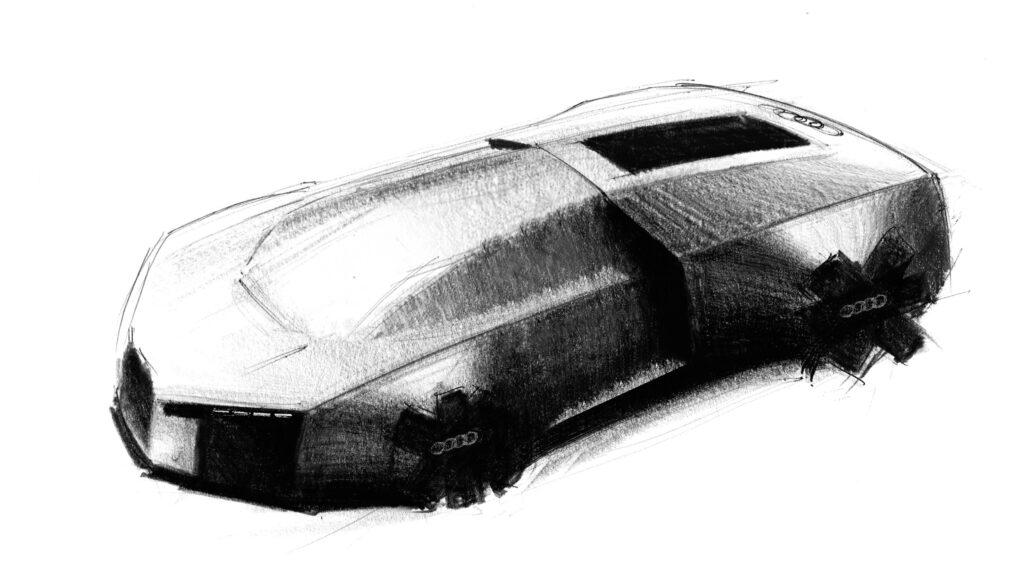
Sketches
How Massimo Frascella’s “Radical Next” gives Audi a new visual direction
There are moments in automotive design when a concept car is not really about the car alone. It becomes a message. It tells us where a brand wants to go, what it wants to leave behind, and how it wants to be seen again.
The Audi Nuvolari is one of those moments.
Strictly speaking, Audi describes the Nuvolari as a near-production prototype rather than a traditional concept car. But from a design perspective, it clearly functions as a concept-level statement. It is not merely a future supercar preview. It is Audi’s attempt to re-establish a strong design identity at a time when many premium brands are struggling with over-complexity, digital overload, aggressive graphics, and a loss of visual clarity.
Under Chief Creative Officer Massimo Frascella, Audi is presenting a new design philosophy called “The Radical Next.” The Nuvolari is one of the first physical demonstrations of what that means when translated into a high-performance object. It follows the Audi Concept C as part of a broader reset: reduced, technical, intelligent, emotional.
For Audi, this matters. For many years, Audi design was admired for its precision, proportion, restraint, and technical coolness. The original TT, the A2, the first R8, the early A5, and several generations of A6 and A8 showed that Audi did not need to shout. Audi was about discipline. The design language was clean, architectural, and quietly confident. But in recent years, like many manufacturers, Audi has often moved toward busier surfaces, larger grilles, more complex light graphics, and increasingly heavy visual treatment.
The Nuvolari suggests a different future. It is not timid. It is not retro. It is not minimal in the weak sense of being empty or generic. Instead, it tries to recover Audi’s lost strength: the ability to create presence through clarity.

A different kind of supercar statement
Most modern supercars are designed to appear violent before they even move. They rely on slashes, scoops, exposed aero devices, fragmented surfacing, and theatrical drama. That approach can be effective, but it often creates visual noise. The car becomes a collage of performance signals rather than a single coherent object.
The Nuvolari takes a more disciplined path.
Its design is built around a monolithic body volume, taut surfacing, and carefully integrated technology. The mid-engine layout gives it the necessary supercar proportion: a low nose, strong cabin-forward tension, broad rear haunches, and a planted stance. But the interesting part is not simply that it has the right proportions. The interesting part is how Audi chooses to control the drama.
The body does not appear to be carved up for decoration. The volumes are large, solid, and compressed. The surfaces have tension, but not unnecessary turbulence. This gives the car a sculptural quality closer to a precision object than a comic-book supercar.
That is important for Audi. A Lamborghini can be extrovert. A Ferrari can be sensual. A Porsche can be evolutionary and engineering-led. But an Audi supercar should feel different. It should feel technical, composed, and exact. The Nuvolari seems to understand that.
Its power is not communicated through visual aggression alone. It comes through stance, mass, proportion, and surface control.

The vertical frame: a new Audi face
One of the most important design elements is the new vertical frame.
For years, the Audi Singleframe grille became one of the strongest front-end signatures in the premium segment. It gave Audi identity and instant recognition. But as EVs and hybrids evolve, the traditional grille has become more difficult to justify visually. Many brands either fake the old grille, remove it entirely, or turn the front end into a digital lighting panel.
Audi’s new vertical frame appears to be an attempt to solve that problem. Instead of treating the front as a conventional intake opening, the frame becomes a graphic and structural identity element. It gives the car a recognizable face without relying on old combustion-era grille logic.
On the Nuvolari, this is especially interesting because the car is not a pure EV. It is a high-performance hybrid with serious thermal and aerodynamic requirements. That means the front end cannot simply be a blank design exercise. Airflow, cooling, brake management, downforce, and brand identity all have to work together.
This is where the Nuvolari becomes more than styling. The front end has to communicate Audi’s new design identity while also supporting the technical requirements of a 1,001 PS hybrid supercar. The vertical frame, front intakes, S-duct, and light signature must read as one system rather than a collection of unrelated features.
That is the real design challenge. In a modern performance car, nothing can be purely decorative. The danger is that function becomes visually chaotic. Audi’s task is to turn function into order.

Surfaces: restrained, but not passive
The Nuvolari’s surfaces appear to follow a principle that Audi once mastered better than almost anyone: tension without fuss.
A good Audi surface should never feel soft or lazy. It should feel machined, controlled, and under pressure. But it should also avoid exaggerated muscle. The Nuvolari’s body side seems to work in that tradition. The car carries power through the way the body volume sits over the wheels, not through unnecessary character lines.
This is a major difference from many contemporary performance cars. Instead of adding graphics to create excitement, the Nuvolari relies on the quality of the main body volume. The side view appears clean, but not plain. The drama comes from the relationship between cabin, shoulder, wheelbase, and rear mass.
In design terms, that is a more mature solution.
It also places much higher pressure on execution. When a car has many creases and decorative elements, those features can distract from proportion or surface quality. When a car is reduced, every radius, section, shutline, highlight, and transition becomes more important. Simplicity is not easier. It is often less forgiving.
That is why this direction is promising for Audi, but also risky. If production execution is not exact, the car could look under-designed. If the surfaces are too heavy, it could look static. If the graphics are too strong, they could overpower the purity. The success of this design depends on millimeter-level discipline.

Titanium and carbon: color as identity, not decoration
Audi’s use of Titanium as a signature color is a smart move. Silver and grey have long been part of Audi’s visual world, not only because of German motorsport history, but because they suit the brand’s character. Audi looks natural in technical metallic tones. These colors emphasize surface quality, precision, and light control.
On the Nuvolari, Titanium is combined with carbon elements. This could easily become predictable. Carbon fiber has been overused in performance cars for decades, often as a visual shortcut for “sporty” or “expensive.” But in the Nuvolari, carbon has a deeper role because the body construction itself uses carbon exterior components over an Audi Space Frame approach.
That changes the meaning. The carbon is not just trim. It is part of the car’s construction logic.
This is where the design becomes authentically technical. A material should not be shown merely because it is fashionable. It should be shown when it explains something about the object. If the Nuvolari can make carbon feel structural, precise, and necessary rather than decorative, it will fit perfectly within Frascella’s stated direction: technology should be present, but not dominant.

Aerodynamics as invisible intelligence
The Nuvolari’s aerodynamic package is one of the most interesting aspects of the design. Modern supercars often expose aerodynamic devices as visual theatre. Wings, blades, fins, and ducts become the main character of the car. The Nuvolari appears to take a more integrated route.
The active rear wing, front S-duct, splitter, diffuser, brake cooling, and thermal management all have major functional roles. But the design intention seems to be that these elements should belong to the overall body rather than visually tearing it apart.
This is very Audi.
Audi’s best designs have always had a certain hidden intelligence. You sense that the car is technical, but the design does not need to explain every technical decision loudly. The technology is embedded. It becomes part of the experience rather than a graphic advertisement.
The deployable rear wing is a good example. In its closed position, the car can retain a cleaner, more reduced silhouette. In higher-performance settings, the wing becomes active and visible. That gives the car two characters: a pure sculptural object at rest, and a more explicit aerodynamic machine at speed.
This duality is important. The Nuvolari is not only designed to sit on a show stand. It is designed around changing states: electric driving, balanced road use, dynamic driving, track mode, high downforce, low downforce, DRS. The design therefore has to express performance without becoming visually locked into one fixed theatrical pose.

A supercar with an Audi brain
The most significant part of the Nuvolari may not be the power output. It may be the system logic behind the performance.
Audi’s quattro identity has always been about control. Not wildness. Not danger. Control. The original quattro changed rallying and gave Audi a technical foundation that still defines the brand. The Nuvolari’s “quattro predictive ride” appears to reinterpret that idea for the hybrid, software-driven era.
This matters for design because the character of a car should be visible in its form. If the Nuvolari is about predictive control, integrated systems, and intelligent performance, then the exterior should not look chaotic. It should look powerful but calculated. It should look fast, but not unstable. It should look technical, but not overloaded.
That is the difference between an Audi supercar and a generic hypercar.
A generic hypercar says: look how extreme I am.
An Audi supercar should say: look how precisely this all works.
The Nuvolari’s design appears to aim for that second message.

The interior: clarity and control
The interior continues the same philosophy. Audi describes it as focused on the act of driving, with essential controls placed within the driver’s field of view. That sounds obvious, but it is actually a major statement in today’s car industry.
Many modern interiors have become screen-first environments. They are often impressive at first glance, but increasingly distracting in real use. They confuse digital sophistication with user experience. Audi, at its best, understood interface design long before the term UX became fashionable. The tactile feel of a switch, the damping of a rotary controller, the clarity of an instrument cluster, the logic of the air vents — these things used to matter deeply.
The Nuvolari seems to return to that way of thinking.
A serious driver’s car does not need to overwhelm the driver with information. It needs to prioritize. The driver should receive what is necessary, when it is necessary, with minimal friction. Secondary information should remain available, but not visually dominant.
The two-zone interior color concept is also interesting. A darker front section supports focus and concentration, while a lighter rear zone introduces contrast and depth. This is not just color styling. It is a spatial strategy. It turns the cabin into a forward-focused control environment rather than a lounge.
The reference to the Auto Union Type C through HMI color accents also feels appropriate if handled with restraint. Heritage should not become costume. It should act as memory, not nostalgia. If the Nuvolari uses that reference subtly, it can connect Audi’s motorsport past to a future performance language without becoming retro.

The influence of Massimo Frascella
Massimo Frascella’s design philosophy is clearly visible in the Nuvolari’s direction. Coming from a background that includes Bertone, Ford, Lincoln/Mercury, Kia, and Jaguar Land Rover, Frascella brings a broad understanding of both emotional sculpture and brand discipline.
What is interesting is that he is not simply trying to make Audi more emotional by adding more drama. Instead, he seems to argue that emotion can come from reduction.
That is a very important point.
For many brands, “emotional design” has become synonymous with exaggerated styling. Bigger grilles. Sharper lights. More aggressive faces. More muscular surfaces. More digital animation. More everything.
Frascella’s interpretation appears different. Emotion comes from clarity, confidence, and the courage to remove what is unnecessary. That links directly back to the original TT, a car he has personally referenced as an important Audi moment. The TT was not successful because it was complicated. It was successful because it was memorable, pure, and almost inevitable. You could recognize it instantly from its silhouette.
The Nuvolari is obviously a very different object. It is far more powerful, far more expensive, and far more complex. But the ambition is similar: create a form that does not need to explain itself through noise.

Why the Nuvolari matters for Audi’s future
The Nuvolari is limited, expensive, and extreme. Most people will never see one on the road. In commercial terms, it will not define Audi’s volume business. But as a design statement, it could be very important.
Halo cars influence everything below them. They give designers permission. They establish new proportions, graphics, material logic, lighting signatures, interface principles, and emotional direction. The Nuvolari’s real value may not be the 499 units Audi plans to build. Its real value may be what it allows Audi to do next.
If the vertical frame, reduced surfacing, integrated aero, technical color palette, and driver-focused interior logic filter down into future production Audis, this concept could mark a serious turning point.
Audi needs that. The premium market has become crowded with brands trying to look futuristic. But the future does not automatically mean more screens, more lighting animation, more decorative surfaces, or more aggression. The future can also mean greater clarity.
That is where Audi has an opportunity.
A future Audi should not try to out-Lamborghini Lamborghini, out-Porsche Porsche, or out-Mercedes Mercedes. Audi’s lane is different. It should be the brand of intelligent precision, technical calm, and controlled emotional tension.
The Nuvolari points in that direction.
A few critical observations
The Nuvolari is impressive as a design statement, but its success will depend on how honestly Audi follows through.
First, the vertical frame must prove adaptable. It works as a strong identity element on a low supercar, but Audi will need to make it convincing on sedans, SUVs, crossovers, EVs, and possibly more affordable models. A design signature is only successful if it can evolve without becoming repetitive.
Second, the promise of “nothing decorative” is difficult to maintain. In a supercar, almost every opening and aerodynamic feature can be functionally justified. On mainstream vehicles, the temptation to imitate those features cosmetically will be strong. Audi must avoid turning functional purity into fake sportiness.
Third, the interior philosophy must survive production reality. A reduced, driver-focused cockpit sounds right, but modern regulations, infotainment expectations, connectivity requirements, and cost pressures can quickly add complexity. If Audi truly believes in clarity, it must protect the user experience as strongly as the exterior design.
Fourth, Audi must be careful with exclusivity. A limited supercar can create desire, but it can also feel disconnected from the rest of the brand. The Nuvolari will only matter if its thinking influences cars that more customers can actually experience.

Final verdict: a serious design reset
The Audi Nuvolari is not just a supercar. It is a design manifesto.
It suggests that Audi is trying to recover the discipline that once made the brand visually distinct, while translating that discipline into a new era of hybrid performance, active aerodynamics, carbon construction, digital control, and Formula 1-inspired thinking.
The best part of the Nuvolari is not that it has over 1,000 PS. Numbers are easy to communicate but hard to own. Someone will always build something faster. The more important achievement is that the car appears to know what kind of supercar an Audi should be.
Not the loudest.
Not the most theatrical.
Not the most nostalgic.
But precise, technical, reduced, intelligent, and emotionally controlled.
If Audi can apply this same confidence to its next generation of production cars, the Nuvolari may be remembered not only as the brand’s fastest and most powerful road car, but as the moment Audi rediscovered the power of clarity.
For a brand built on “Vorsprung durch Technik,” that may be exactly the right kind of progress.