Europe’s Car Industry Must Stop Treating Software as an Accessory
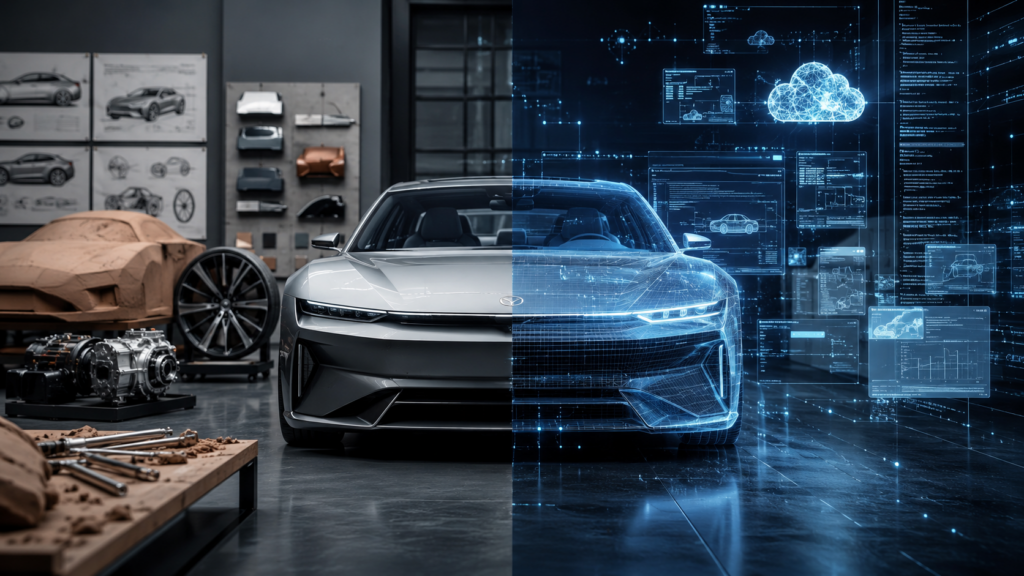
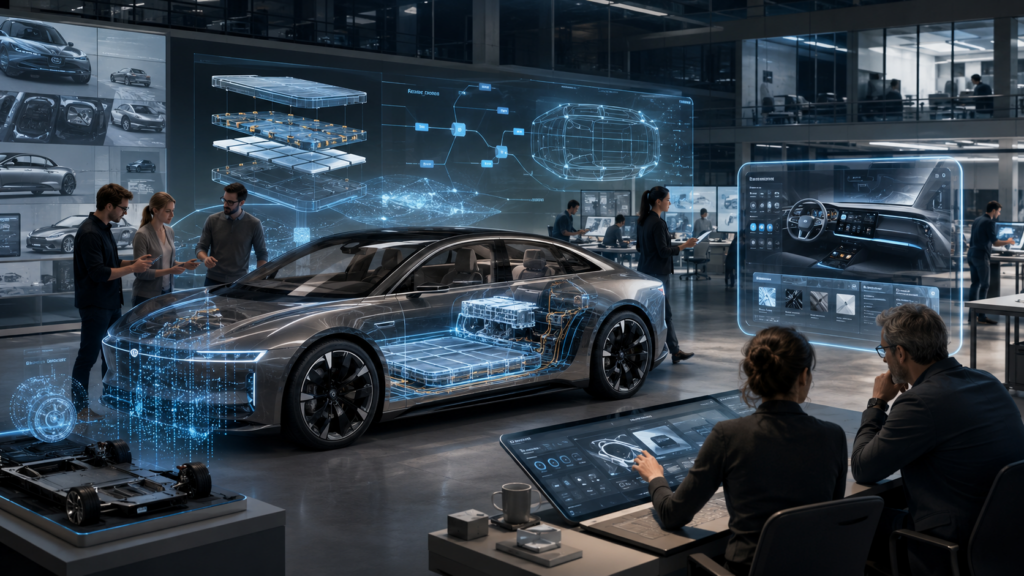
Why a software-first mindset is now as important to automotive design as proportion, surfacing, engineering and manufacturing
For more than a century, European carmakers built their reputation on hardware.
Engines, gearboxes, chassis tuning, body structures, crash safety, ride comfort, materials, paint quality, panel gaps, aerodynamic refinement, interior craftsmanship and manufacturing discipline formed the foundation of the European automotive identity. Germany in particular became the global reference for engineering depth. France developed a tradition of comfort, packaging intelligence and design charm. Italy brought emotion, proportion and passion. Sweden built safety and human-centred rationality. Britain added luxury, character and specialist performance.
This hardware culture created some of the greatest cars in history.
But the competitive battlefield has changed.
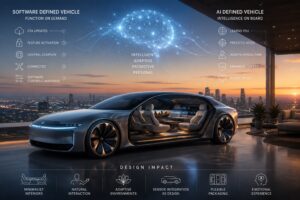
The modern vehicle is no longer just a mechanical product with electronics added to it. It is becoming a software-defined platform, a connected digital device, an energy system, an AI interface, a data node, a user-experience environment and a mobility service container. The mechanical object still matters enormously, but it no longer defines the entire value of the car.
That is the uncomfortable truth now facing European automakers.
Job cuts, factory closures, restructuring plans and supplier pressure are symptoms of a deeper shift. European carmakers are not only facing higher costs or weak demand. They are being challenged by companies that think differently.
Tesla did not approach the car primarily as a traditional car company. Many Chinese EV makers do not approach the car primarily as traditional car companies either. They think in terms of platforms, software cycles, digital experience, data, battery integration, consumer electronics, speed of iteration and ecosystem control.
Europe still too often thinks in terms of model cycles, hardware programs, brand hierarchy, factory utilization, supplier sourcing and trim derivatives.
That difference is now visible in the market.
And it is becoming existential.
The old automotive mindset
The traditional automotive development process was built around hardware.
A new vehicle program might take five, six or seven years from strategy to showroom. The platform was defined. Hard points were frozen. Styling moved through concept, scale model, full-size clay, feasibility, tooling and release. Engineering systems were developed in parallel. Suppliers were nominated. Manufacturing was prepared. The car was launched. Then it remained largely fixed until the facelift, and again until the next generation.
This system made sense when the main product was mechanical.
An engine could be improved during a model cycle, but the customer did not expect the car to evolve every month. The dashboard did not need over-the-air updates. A door handle was a door handle. A steering wheel was a steering wheel. A climate system was controlled by physical buttons. Navigation, if fitted, was a luxury feature rather than the core of the user experience.
The car was finished when it left the factory.
That is no longer true.
A modern vehicle is increasingly unfinished at delivery. Not in the sense of poor quality, but in the sense that much of its value can evolve after the customer takes possession. Driver-assistance systems can improve. Battery management can change. Charging behaviour can be optimized. Navigation can become smarter. Voice control can learn new functions. Infotainment can gain services. Energy use can be refined. User profiles can migrate. Apps can be added. Faults can be corrected without a dealer visit.
The vehicle becomes a living platform.
That is a fundamentally different industrial logic.
The Tesla lesson
Tesla’s greatest disruption was not only that it made electric cars desirable. Its deeper disruption was that it changed customer expectations.
The Model S showed that a car could behave more like a digital product. It could receive over-the-air updates. It could improve after purchase. It could use a central screen as the main interface. It could simplify the hardware and move functions into software. It could create a direct relationship between manufacturer and customer. It could make software part of the ownership experience, not merely a hidden engineering layer.
Many traditional automakers misunderstood this.
They saw the large screen and copied the screen.
They saw the EV drivetrain and copied the EV drivetrain.
They saw the minimalist interior and copied the minimalism.
They saw the over-the-air update capability and tried to add OTA.
But the real lesson was organizational.
Tesla was not simply adding software to a traditional car. It was building the car around a software-and-electronics architecture. That changed how quickly it could change, how directly it could interact with customers, and how much control it had over the user experience.
The result was not perfect. Tesla has also made serious design and ergonomic compromises, especially in its over-reliance on screen control and its willingness to remove physical interfaces. But the company understood one thing earlier than most legacy manufacturers:
The car was becoming a software platform.
Europe saw that, but did not fully absorb it.
The Chinese acceleration
China has taken the software-defined vehicle idea in a different direction.
Chinese EV makers have combined rapid product development, battery supply-chain depth, software integration, aggressive pricing, digital lifestyle features, local-market speed and increasingly confident design. Their vehicles often arrive with more screens, more connectivity, more perceived technology, more driver-assistance content, faster feature updates and more willingness to experiment.
Not all of this is good design. Some Chinese EVs are overloaded with screens, lighting gimmicks and feature lists. But the speed is undeniable.
Chinese automakers have learned to treat the car as an evolving technology product. They iterate faster. They localize faster. They respond to user trends faster. They integrate battery, electronics and software more directly. They also increasingly understand that digital experience is not an afterthought; it is a purchase reason.
This has created a serious problem for European brands.
A European car may still have better ride quality, better steering feel, better restraint systems, stronger structural engineering, better long-term durability, more mature chassis behaviour or a more refined brand heritage. But if the customer’s daily interaction with the car feels slow, confusing, outdated or inferior, those deeper engineering qualities may not be enough.
The customer touches the interface every day.
The customer sees the screen every day.
The customer experiences the software every day.
If that experience feels behind, the car feels behind.
Europe’s hidden weakness: excellent hardware, fragmented software
European manufacturers are not incapable of software. They employ brilliant engineers and have enormous technical resources. The problem is structural.
Traditional carmakers were built as hardware organizations. They outsourced many electronic modules to suppliers. Different functions came from different vendors. Electronic control units multiplied. Software was distributed across the car in separate systems. Integration was complex. Responsibility was fragmented. A supplier might control one subsystem, another supplier another, while the OEM tried to coordinate the whole orchestra.
That worked when software was supporting hardware.
It does not work when software becomes the product experience.
A software-defined vehicle needs a fundamentally different architecture: fewer, more powerful computing units; centralized or zonal electronics; common middleware; clear update pathways; cybersecurity from the start; cloud connectivity; data feedback loops; integrated UX; faster development cycles; and internal software ownership strong enough to define the customer experience.
This is where Europe has struggled.
The industry knows the direction. It has been discussing software-defined vehicles for years. But knowing the direction is not the same as building the organization, architecture and culture to get there.
The cost-cutting trap
When sales are under pressure, factories are underused and margins fall, the instinct is to cut costs.
That is understandable. European automakers face real structural disadvantages: high labour costs, complex regulation, expensive energy, legacy plants, political constraints, union negotiations and heavy investment requirements for electrification and software. Restructuring may be unavoidable.
But cost-cutting alone cannot create competitiveness.
A company cannot shrink its way into relevance.
If European automakers respond to Tesla and China mainly by reducing headcount, closing plants and simplifying model ranges, they may improve short-term financial metrics while weakening the long-term product. The real question is not only how many people are employed. It is what kind of capability remains inside the company.
If a manufacturer cuts mechanical overcapacity but fails to build software capability, it has not transformed. It has only become a smaller version of the old company.
The danger is that Europe reduces its industrial base without gaining the new competence it needs.
Software-first does not mean hardware no longer matters
There is an important misunderstanding in the phrase “software-first.”
Software-first should not mean hardware becomes secondary or cheap. It should not mean abandoning ride comfort, safety, ergonomics, craftsmanship, reliability, proportion, packaging or emotional design. That would be a disaster, especially for European brands whose authority is rooted in physical excellence.
Software-first means something more precise:
The vehicle must be conceived from the beginning as an integrated hardware-software experience.
The hardware must be designed to support digital evolution.
The electronics architecture must be designed before the feature list becomes fragmented.
The interface must be developed as part of the brand identity.
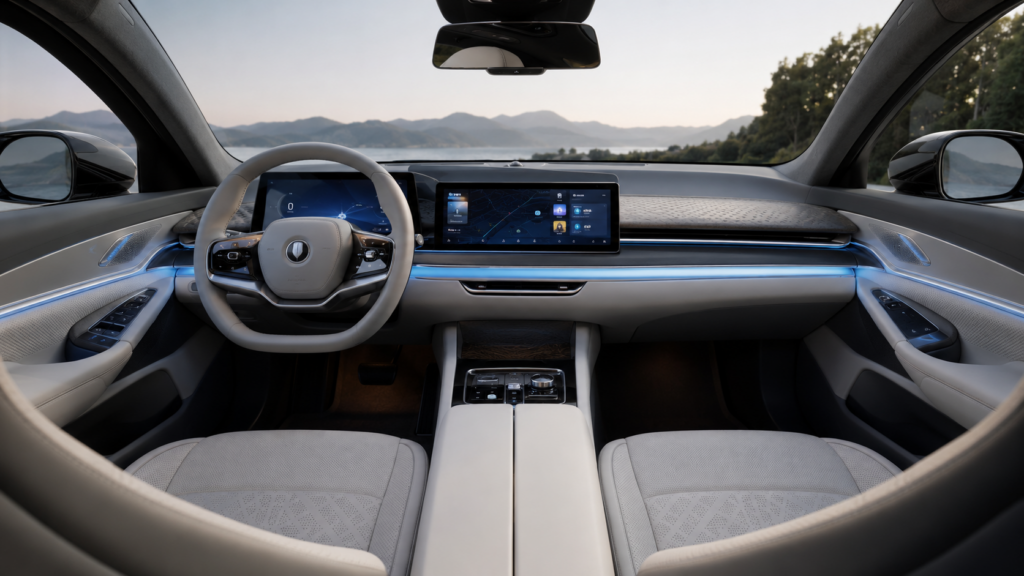
The interior must be designed around human interaction, not just screen placement.
The car must be capable of improving after delivery.
The platform must be able to support future functions without complete reinvention.
The design process must include software behaviour as a visible design material.
This is not anti-hardware. It is the next level of hardware.
A beautiful body over weak software will feel old.
A brilliant interface in a badly packaged car will feel shallow.
The winning vehicle will integrate both.
The new role of automotive design
For car designers, this shift is profound.
Traditionally, exterior design defined much of the emotional value of the vehicle. Proportion, stance, surface, graphics, brand face, wheel placement, cabin position and sculpture created desire. Interior design then translated brand character into materials, seating, controls and architecture.
That remains true, but it is no longer sufficient.
Designers now have to think about:
- the visible interface;
- the behaviour of screens;
- the logic of controls;
- the relationship between physical and digital input;
- the animation of light;
- the sound of warnings;
- the behaviour of driver-assistance systems;
- the emotional quality of software feedback;
- the use of AI inside the cabin;
- the handover between manual and automated driving;
- the way the car greets, guides and reassures the user;
- how updates change the customer’s relationship with the vehicle over time.
In the past, a designer could say, “That is HMI,” and leave it to a specialist team. That separation is no longer acceptable. HMI, UX, lighting, sound, physical controls, display graphics, seating posture and interior architecture are now one continuous design problem.
The cabin is becoming a digital-physical environment.
That is design.
The mistake of replacing buttons with screens
One of the most visible mistakes of the software era has been the assumption that software-first means screen-only.
It does not.
Many automakers copied Tesla’s screen dominance without understanding that the goal should not be fewer buttons for its own sake. The goal should be a better user experience. Removing physical controls can simplify manufacturing and create a clean interior, but it can also damage safety, usability and emotional quality.
Climate control hidden in menus is not progress.
Mirror adjustment buried in software is not luxury.
A glovebox opened through a screen is not intelligent design.
A steering wheel without intuitive tactile feedback is not modernity.
A car that forces the driver to look away for basic functions is not advanced.
This is where European brands have an opportunity.
Europe should not try to out-Tesla Tesla by copying the worst parts of minimalism. It should create a more mature software-defined interior: digital where digital is best, physical where physical is safer, faster and more satisfying.
The best future car interior will not be a tablet with seats around it. It will be a carefully orchestrated human interface.
Brand identity must become digital
European brands have spent decades defining physical brand identity.
A BMW had a kidney grille, driver orientation and certain dynamic feel.
A Mercedes had comfort, prestige and engineering confidence.
An Audi had technical clarity, quattro, lighting precision and interior discipline.
A Volvo had safety, calmness and Scandinavian humanism.
A Porsche had driver focus, mechanical integrity and unmistakable proportion.
A Peugeot had expressive form and French character.
A Renault could be inventive and human.
A Volkswagen was supposed to be intelligent, honest and correct.
But what is the digital identity of these brands?
What should a Mercedes software experience feel like compared with a BMW?
What should a Volvo driver-assistance handover feel like?
What should an Audi interface sound like?
What should a Porsche EV update experience communicate?
What should a Volkswagen voice assistant be: playful, efficient, invisible, reassuring?
What should a Renault digital cabin do differently from a Peugeot?
These are not minor questions.
If all brands use similar screens, similar icons, similar voice systems, similar ADAS graphics, similar app stores and similar update messages, brand identity becomes thinner. The digital layer can either strengthen brand character or erase it.
European automakers must design digital brand identity with the same seriousness they once applied to grilles, lamps, dashboards and door handles.
Software as luxury
Luxury used to be defined by leather, wood, chrome, silence, power and craftsmanship. Those still matter. But in the future, software will become part of luxury.
Luxury will mean the car recognizes you without fuss.
Luxury will mean the climate system anticipates comfort.
Luxury will mean navigation understands charging, traffic, personal preference and arrival experience.
Luxury will mean the car updates without anxiety.
Luxury will mean driver-assistance feels smooth, natural and trustworthy.
Luxury will mean the interface is beautiful but not distracting.
Luxury will mean the car protects your privacy.
Luxury will mean the software does not make the vehicle feel obsolete after three years.
This is especially important for premium European brands.
A luxury car with irritating software is no longer a luxury car. It is an expensive object with a daily annoyance built into it.
That is unacceptable.
The challenge of software reliability
Traditional automakers are right to be cautious in some areas.
A smartphone can crash and restart. A car cannot behave that way. Automotive software must satisfy functional safety, cybersecurity, regulatory, homologation and liability requirements that consumer electronics companies do not face in the same way. Brake systems, steering, battery management, thermal control, airbag logic, driver assistance and charging must be robust and fail-safe.
This is why the transition is difficult.
But it is not an excuse for poor user software. It means automotive software must be developed with a different level of discipline. Fast does not mean careless. Software-first does not mean beta-testing safety-critical systems on customers.
The future belongs to companies that can combine speed with responsibility.
Tesla has shown speed.
China has shown speed and scale.
Europe must show speed plus trust.
That could become Europe’s competitive advantage if it moves decisively.
The supplier relationship must change
European automakers traditionally relied heavily on suppliers for components and systems. That model created efficiency and specialization, but it also created dependency.
In the software-defined vehicle, the OEM must own the customer-facing experience. It can still partner. It can still buy technology. It can still collaborate with suppliers, chip companies, cloud providers and software specialists. But it cannot outsource the soul of the car.
The software architecture, data strategy, interface philosophy, update logic and brand experience must be controlled by the manufacturer.
If the OEM becomes merely an integrator of supplier black boxes, it loses control of its future.
This is a major cultural change. It requires new talent, new management structures, new speed, new validation processes and new willingness to let software teams influence hardware decisions earlier.
The old hierarchy — design, engineering, purchasing, suppliers, validation, launch — must become more integrated.
China as innovation engine
One of the most telling signs of the new automotive order is that legacy automakers are increasingly using China not only as a manufacturing base, but as an innovation base.
For decades, Western automakers went to China for market access, volume growth and production partnerships. Now many are relying on China for EV development speed, local software, intelligent cockpit systems, battery integration and digital feature expectations. This is a remarkable reversal.
China is no longer only learning from Europe. Europe is now learning from China.
That does not mean European design and engineering are finished. But it does mean the centre of innovation has shifted. If European companies must go to China to develop the vehicles that will compete globally, then the European home organization has a capability problem.
The lesson is not to reject China. Collaboration may be necessary and valuable. The lesson is that Europe must rebuild speed and software competence at home as well.
A region that only protects factories but does not develop future technology will still decline.
The design danger: software without soul
There is also a danger in the opposite direction.
If automakers become obsessed with software, they may forget what makes cars emotionally powerful. A car is not just a device. It is a spatial experience, a physical object, a movement companion, a symbol, a tool, a shelter, a performance instrument and often an expression of personal identity.
Chinese EVs and Tesla have sometimes shown the weakness of technology-led design: fast, clever, screen-rich and feature-heavy, but not always emotionally deep. Some products feel impressive in a showroom and less memorable as design objects. Others age quickly because their appeal is tied to novelty.
European brands should not abandon their strength in proportion, material, motion, comfort and emotional design. They should integrate software into those strengths.
The goal is not to become Silicon Valley.
The goal is not to become Shenzhen.
The goal is to create a European software-defined vehicle culture.
That culture should combine digital intelligence with physical excellence.
What a European software-first car should be
A truly modern European software-first vehicle should have several qualities.
It should have a clean electronic architecture that allows meaningful updates.
It should have an interface that is beautiful, intuitive and brand-specific.
It should preserve physical controls where they improve safety and speed.
It should use AI carefully, as assistance rather than gimmick.
It should allow personalization without turning the car into a toy.
It should be designed for long-term software support, not planned digital obsolescence.
It should protect privacy as part of premium trust.
It should make charging, navigation and energy management effortless.
It should use digital systems to improve comfort, safety and performance invisibly.
It should make the car feel more valuable over time, not less.
Most importantly, it should be designed as one whole object.
Not hardware first, then software added.
Not software first, with poor physical usability.
But human experience first, delivered through integrated hardware and software.
That is the real target.
The workforce question
The job-cut discussion should therefore be reframed.
The question is not simply how many jobs Europe can preserve. The question is what kind of automotive work Europe wants to lead.
Some traditional manufacturing roles will inevitably decline as EVs require fewer mechanical parts and as factories become more automated. But new roles must grow: software engineers, UX designers, data-security specialists, AI safety experts, battery-software specialists, OTA validation engineers, cloud architects, HMI designers, simulation experts and digital-service teams.
If Europe only loses old jobs without building new ones, it loses twice.
The transition must therefore be industrial, educational and cultural. Europe needs software competence inside car companies, but also in suppliers, universities, design schools, technical institutes and regulatory bodies.
A software-defined car industry cannot be created by press releases. It requires a software-defined talent base.
What this means for Car Design TV readers
For designers, strategists and car enthusiasts, this is a turning point.
We can no longer judge cars only by exterior style, powertrain, badge and materials. We must judge the complete operating experience.
Does the car’s software support the design intent?
Does the interface match the brand?
Does the digital system make the car easier or more irritating?
Does the screen architecture improve the interior or dominate it?
Does the lighting communicate meaning or decoration?
Does the driver-assistance system feel trustworthy?
Does the car improve after delivery?
Does the manufacturer control the experience or merely assemble supplier systems?
These questions will increasingly define design quality.
A beautiful car with poor software is no longer complete.
A clever software car with poor ergonomics is also incomplete.
The future belongs to cars that merge both.
Final verdict: Europe must change the operating system of the company, not just the car
The European car industry is not short of talent. It is not short of history. It is not short of engineering capability. It is not short of design intelligence. But it is still too often organized around the logic of the hardware-defined vehicle.
That is the problem.
The shift to software-defined vehicles is not a feature change. It is not about adding larger screens, app stores or over-the-air updates. It is a change in the operating system of the entire company.
Product planning must change.
Design must change.
Engineering must change.
Supplier relationships must change.
Validation must change.
Brand identity must change.
Customer relationships must change.
The idea of when a car is “finished” must change.
Tesla and Chinese rivals have forced this issue into the open. Europe can still compete, but not by defending the past and not by cutting its way into the future. It must build a new kind of automotive competence: software-first, human-centred, physically excellent and emotionally branded.
The great European car of the future will not be a computer on wheels.
It will be something more difficult and more valuable:
a beautifully engineered physical object, designed around people, powered by clean technology, and continuously improved through intelligent software.
That is the next European premium.
And if Europe wants to remain a leader in car design, it must learn to design not only the shape of the car, but the behaviour of the car.