Peugeot E-T16 Concept: The Legendary 205 T16 Reborn for the Electric Era
Input ingredient 0

Peugeot has unveiled one of the most spectacular concepts of the 2026 Paris Motor Show. The new Peugeot E-T16 Concept celebrates the legendary 205 Turbo 16, the car that secured consecutive World Rally Championship titles in 1985 and 1986, while presenting an extreme interpretation of the brand’s future design direction.
With 816 horsepower, three electric motors and acceleration from 0 to 100 km/h in just 2.5 seconds, the E-T16 is the most powerful Peugeot ever created. But beyond its extraordinary performance, the concept is particularly interesting because it combines Peugeot’s rallying heritage with the design language intended for the next-generation E-208.
Rather than simply recreating the original 205 T16, Peugeot has developed a radical electric hyperhatch that explores how the character of its most celebrated competition cars could survive in an entirely different technological environment.

A Modern Interpretation of a Rally Legend
The original Peugeot 205 T16 was one of the defining cars of the Group B rally era. Its wide body, enormous wheel arches, distinctive rear air intakes and aggressive aerodynamic features transformed the relatively modest Peugeot 205 into a competition machine that became an icon of French motorsport.
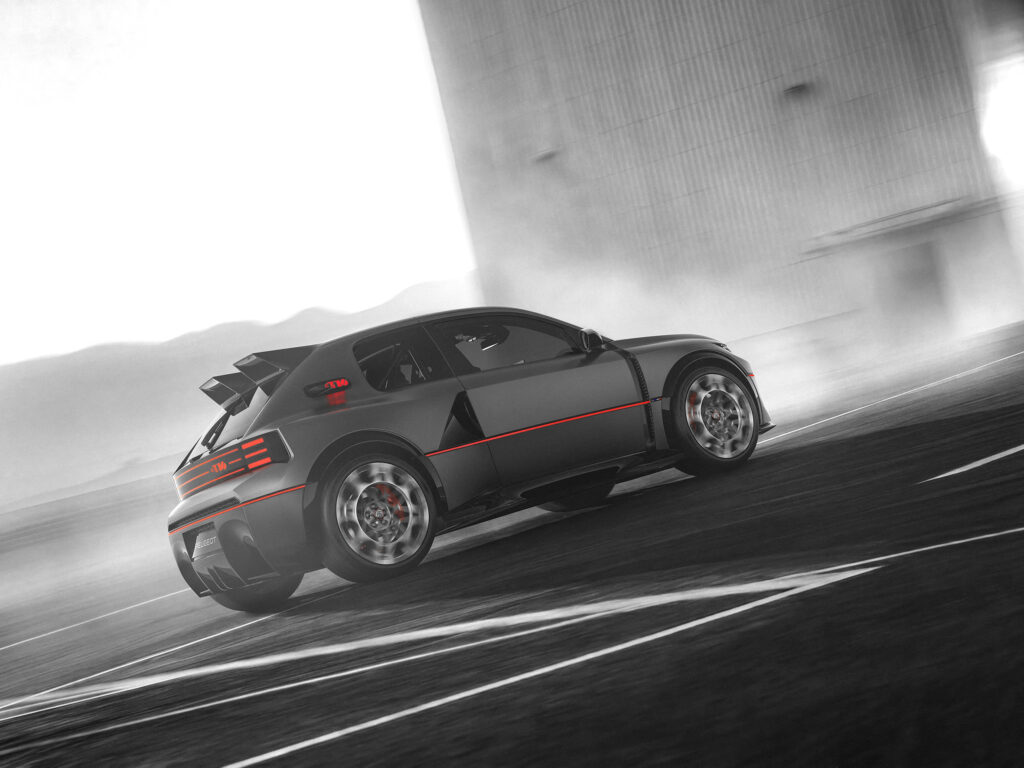
The new E-T16 takes those recognizable characteristics and exaggerates them considerably. Its proportions are dramatically wider and more muscular than those of a conventional hatchback, with oversized wheel arches, an aggressively sculpted bonnet and extensive aerodynamic components.
Peugeot Design Director Matthias Hossann describes the concept as an extreme interpretation of the next-generation E-208, using the proportions of the future production model as the starting point before pushing every element toward maximum performance.
That makes the E-T16 particularly relevant from a design perspective. Although the concept itself is an extreme performance vehicle, some of its underlying design themes are intended to influence Peugeot’s future production cars.

Introducing Peugeot’s Feline Future Design Language
One of the most significant developments is Peugeot’s new Feline Future design language, particularly its reinterpretation of the familiar three-claw lighting signature.
Instead of the predominantly vertical lighting graphics used on recent Peugeot models, the E-T16 introduces three long, slim horizontal illuminated elements at both the front and rear. These frame an illuminated Peugeot emblem while visually emphasizing the vehicle’s width and low stance.
The change is interesting because Peugeot has spent years establishing the three-claw signature as one of its most recognizable design features. Reorienting those elements horizontally creates a distinctly different character without abandoning the established brand identity.
The front-end treatment is supported by three substantial cooling intakes, large air outlets in the bonnet and aerodynamic extractors behind the front wheels. These functional elements give the car a much more aggressive appearance than a conventional electric hatchback, while emphasizing the considerable cooling requirements of its high-performance electric drivetrain.
At the rear, a large wing with distinctive upward extensions, described by Peugeot as cat ears, works together with a twin diffuser and adjustable aerodynamic blades. The overall effect is unmistakably competition-inspired, although considerably more futuristic than the original rally car.

Heritage Details That Actually Mean Something
Some of the most successful design features are the references to the original 205 T16.
The concept’s Winchester Matte Grey paint closely resembles the colour of the historic rally machine, while the silver wheels incorporate body-coloured inserts. A continuous illuminated red line runs around the body, referencing the original car’s red pinstripe.
More interestingly, Peugeot has retained the characteristic air intake ahead of the rear wheels, but given it an entirely new purpose. Where the original intake supplied cooling air to the combustion engine, the modern interpretation incorporates the charging port and door-opening mechanism.
The floating C-pillar is another recognizable feature that has been retained and aerodynamically refined, allowing air to flow more freely toward the rear.
Perhaps the most dramatic reference is the entire rear body section, which tilts upward just as it did on the original 205 T16. Instead of revealing a turbocharged four-cylinder engine, however, the open rear section exposes the two rear electric motors, suspension components and structural elements.
This is an excellent example of heritage design being adapted rather than simply copied. The historical reference remains recognizable, but the engineering underneath it is entirely contemporary.

816 Horsepower and Three Electric Motors
The E-T16’s performance figures are extraordinary, particularly for a vehicle that retains the basic visual identity of a compact hatchback.
Its three-motor electric drivetrain uses one motor at the front and two at the rear, producing a combined 816 hp. The system incorporates torque vectoring, allowing power to be distributed continuously between the rear wheels and between the front and rear axles.
Acceleration from 0 to 100 km/h takes just 2.5 seconds, while the car can reach 300 km/h in approximately 16 seconds. Peugeot claims a power-to-weight ratio of less than 2 kg per horsepower, placing the concept firmly in supercar territory.
The chassis specification is equally serious, with 380 mm brake discs at all four corners, a vertically mounted hydraulic handbrake inspired by rally cars and Michelin tyres measuring 275 mm wide at the front and 315 mm at the rear.
Peugeot Sport has also developed an advanced battery cooling system using technology derived from motorsport. Instead of cooling the battery cells primarily through their bases, the system uses side cooling to improve thermal management during sustained high-performance driving.
Peugeot claims the E-T16 can complete three laps of the Nürburgring Nordschleife in Performance mode without power reduction caused by overheating. That is a particularly relevant achievement because sustained performance remains one of the major challenges for high-output electric sports cars.

An Extreme Electric Car With Usable Range
Despite its competition-inspired appearance, Peugeot has also considered everyday usability.
The concept uses an 800-volt electrical architecture with an 85 kWh battery, providing a claimed WLTP driving range of up to approximately 400 kilometres. Charging from 10 to 80 percent takes less than 15 minutes under suitable conditions.
Those figures suggest that Peugeot is exploring something more sophisticated than a pure track demonstration vehicle. Although the E-T16 is clearly an extreme concept, its electrical architecture is intended to combine high performance with the practical advantages expected from a modern electric vehicle.
Whether such an extreme vehicle would ever make commercial sense is another matter, but it demonstrates how far electric performance technology has progressed beyond the early generation of electric hot hatchbacks.

A Radical New Peugeot i-Cockpit
Inside, the E-T16 introduces the next generation of Peugeot’s i-Cockpit, incorporating the unusual Hypersquare steering control and steer-by-wire technology.
The Hypersquare replaces the traditional circular steering wheel with a compact rectangular control inspired by Peugeot’s 9X8 endurance racing car. In the E-T16, it also incorporates a configurable central display capable of showing speed, lap times and other essential driving information.
Above it sits a curved 21-inch panoramic display combining the main instrumentation and central touchscreen. The arrangement provides a preview of the digital architecture intended for the future E-208, although the concept takes the technology considerably further than a conventional production vehicle.
From an ergonomic perspective, the Hypersquare is one of the most interesting and potentially controversial elements. Steer-by-wire makes it possible to rethink steering control geometry and response, but the success of such a system ultimately depends on whether it provides the precision, feedback and intuitive operation expected from a performance car.
The concept’s cockpit is otherwise unapologetically focused on driving. Carbon fibre, anodised aluminium, technical mesh and a tubular roll cage create an environment much closer to a competition car than a conventional hatchback.
The deeply sculpted bucket seats feature carbon-fibre shells, substantial lateral support and a combination of technical woven fabrics and recycled leather. Red accents continue throughout the interior, including the seats, roof lining and roll cage, establishing a strong visual connection with the exterior’s illuminated red graphic.

What Does This Mean for the Next E-208?
The E-T16 is obviously not a realistic preview of an everyday electric supermini. Its enormous power output, elaborate aerodynamic features and competition-inspired construction place it in a completely different category.
However, the concept does provide important clues about Peugeot’s future design direction.
The horizontal three-claw lighting signature, more sculptural body surfaces, new front-end graphics and next-generation i-Cockpit are all elements that could influence future production models. Peugeot has specifically identified the concept as an extreme vision of the next E-208, making these developments more significant than the usual styling exercises associated with motor-show concepts.
The challenge will be translating that dramatic appearance into a practical, affordable production car without losing the character that makes the concept so appealing.

A Peugeot Worth Getting Excited About
The Peugeot E-T16 Concept succeeds because it connects three important aspects of the brand’s identity: its motorsport heritage, its increasingly distinctive design language and its commitment to developing engaging driving experiences.
The original 205 T16 was an extraordinary example of what could happen when a manufacturer transformed a relatively ordinary production car into a serious competition machine. The E-T16 applies a similar philosophy to the electric era, replacing the turbocharged combustion engine with an exceptionally powerful three-motor drivetrain while retaining many of the visual characteristics that made the original so memorable.
There is undoubtedly an element of excess in the concept. With 816 horsepower, enormous tyres and elaborate aerodynamic devices, it pushes the idea of a performance hatchback far beyond what most drivers could reasonably use on public roads.
Nevertheless, that is partly the point of a concept car. It should explore possibilities, generate excitement and provide a direction for future development.
The E-T16 demonstrates that electrification does not have to mean abandoning the emotional appeal of performance cars. More importantly, it shows that Peugeot still understands the value of its extraordinary motorsport history and is prepared to reinterpret that heritage rather than simply preserve it.
If even a fraction of the E-T16’s design character makes its way into the next-generation E-208, Peugeot’s future small cars could become considerably more interesting.