Renault E-Space Concept: Rediscovering the Art of the Family Car


Renault has introduced the E-Space Concept at the 2026 Paris Motor Show, presenting a contemporary interpretation of one of the most influential vehicles in the company’s history. More than four decades after the original Renault Espace helped establish the European MPV, the new concept explores how the philosophy of spacious, comfortable and versatile family transportation could evolve in the electric era.
At a time when SUVs have almost completely replaced traditional MPVs, Renault’s decision to revisit the Espace philosophy is particularly interesting. Rather than concentrating exclusively on rugged styling, elevated driving positions and increasingly aggressive proportions, the E-Space Concept returns to an idea that once distinguished Renault from many of its competitors: designing the automobile around the people who use it.
The concept forms part of Renault’s broader voitures à vivre philosophy, which translates roughly as cars designed for living. It is an approach that places passenger comfort, usable interior space and everyday functionality at the centre of the design process, rather than treating them as secondary considerations.

Reinterpreting an Automotive Pioneer
When Renault introduced the original Espace in 1984, its unconventional one-box architecture represented a fundamental departure from traditional family-car design. Instead of adapting a conventional saloon or estate car to accommodate more passengers, Renault developed a vehicle around the interior space required by its occupants.
The resulting proportions were unusual for their time, with a relatively short bonnet, generous glass area and a tall passenger compartment. These characteristics were not simply styling decisions but direct consequences of prioritising interior packaging and versatility.
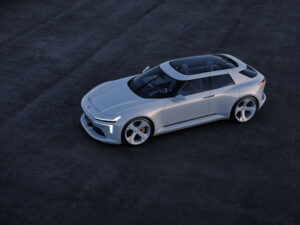
The E-Space Concept revisits that philosophy without attempting to reproduce the original vehicle. Measuring 4.70 metres long, it adopts more contemporary proportions and a stronger visual presence while retaining the idea that a family vehicle should offer a welcoming and generously proportioned passenger environment.
This is an important distinction. The original Espace became successful because it challenged conventional assumptions about automotive packaging. A meaningful modern reinterpretation should therefore explore new possibilities rather than simply recreating the familiar silhouette of the first-generation model.

A More Sculptural Approach to Family Transportation
The E-Space Concept introduces a distinctive exterior design finished in an elegant shade Renault calls Black Rubé, giving the bodywork a rich, sophisticated appearance.
Its proportions suggest a more sculptural interpretation of the family vehicle, combining a substantial body with a carefully integrated passenger compartment. The emphasis is on creating a recognizable, contemporary design without abandoning the generous interior space traditionally associated with the Espace name.
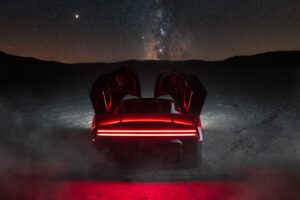
One of the concept’s most prominent features is its new lighting signature. A wide U-shaped light strip extends across both the front and rear, following the contours of the body and emphasizing its width.
At the front, an illuminated Renault diamond appears to float within a composition of subtle pixel-like lighting elements. This creates a more technical and futuristic interpretation of the brand’s identity, replacing the traditional emphasis on a radiator grille with a distinctive illuminated graphic.
From a design perspective, this approach reflects an important development across the automotive industry. As electric vehicles require less conventional front-end cooling, manufacturers are increasingly using lighting architecture to establish brand recognition. The challenge is to create something distinctive without allowing illuminated graphics to overwhelm the underlying body sculpture.
Renault’s E-Space Concept suggests a direction in which lighting becomes an integrated part of the vehicle’s architecture rather than simply an additional decorative feature.

The Interior as the Starting Point
Perhaps the most significant aspect of the E-Space Concept is Renault’s emphasis on the passenger experience.
The company describes the concept as a contemporary vision of travel and family mobility, with the interior intended to be generously proportioned, technologically advanced and welcoming. This reflects Renault’s belief that the automobile should function as more than a means of transportation.
Renault identifies four principles behind this approach: Design to be loved, Electrified by passion, Human-first tech and Crafted space. Together, they suggest a design philosophy in which technology should improve the experience of travelling rather than simply introduce more functions and digital interfaces.
This is particularly relevant to family vehicles, where comfort, accessibility, visibility and intelligent storage often matter considerably more than dramatic performance figures or elaborate dashboard displays.
The original Espace demonstrated how fundamentally different a vehicle could become when designers were given the freedom to prioritise its occupants. The new concept raises the question of whether contemporary electric architectures could provide similar opportunities for interior innovation.
Renault has not detailed the E-Space Concept’s seating configuration, interior dimensions or specific cabin technologies in the accompanying announcement, so the extent of that innovation remains to be assessed.
Electrification Creates New Opportunities
The E-Space Concept also represents Renault’s broader strategy of developing vehicles around electrified powertrains.
The name itself combines E-Tech, Renault’s designation for its electrification technologies, with the familiar Espace reference to generous interior accommodation.
Electric vehicle architectures can provide considerable packaging advantages, particularly when mechanical components are distributed differently from those in conventional combustion-engine vehicles. Reduced requirements for engine compartments and transmission tunnels can create opportunities for more flexible cabin layouts.
For a vehicle intended to carry families comfortably over longer distances, these possibilities could be particularly valuable. However, the positioning of the battery, floor height and seating arrangements will remain critical to achieving an efficient relationship between exterior dimensions and usable interior volume.
Renault has not announced detailed powertrain specifications, battery capacity or driving range for the E-Space Concept. It is therefore best understood as a design and mobility study rather than a technical preview of a confirmed production vehicle.

Is It Time to Reconsider the MPV?
The E-Space Concept arrives at an interesting moment for the European automotive market.
Over the past two decades, the traditional MPV has steadily disappeared as manufacturers and customers increasingly favour SUVs and crossovers. Yet the popularity of SUVs has not eliminated the fundamental advantages of vehicles designed specifically around passenger accommodation.
A well-executed MPV can offer excellent interior space, convenient access, flexible seating and substantial luggage capacity without necessarily requiring the elevated proportions or rugged visual character of an SUV.
Electrification may create an opportunity to reconsider these advantages. With greater freedom in vehicle architecture, manufacturers could develop family cars that combine efficient exterior dimensions with more innovative interior arrangements.
The challenge for Renault will be to make such a vehicle desirable again. Practicality alone is rarely sufficient in a market where appearance, perceived status and emotional appeal strongly influence purchasing decisions.
The E-Space Concept appears intended to address precisely that challenge by combining the traditional Espace philosophy with a more expressive and contemporary exterior design.

A Welcome Return to Renault’s Innovative Roots
Renault has demonstrated considerable confidence in revisiting its heritage, particularly through recent interpretations of the Renault 4, Renault 5 and other historically significant models. However, the E-Space Concept explores a somewhat different aspect of the company’s identity.
Rather than celebrating a compact city car or an enthusiast-oriented performance model, it returns to Renault’s history of unconventional family transportation.
The original Espace was significant because it challenged the established relationship between vehicle architecture, exterior design and interior functionality. It offered a genuinely different approach to the family car at a time when most manufacturers were still working within conventional saloon and estate-car proportions.
The E-Space Concept has the opportunity to revive that spirit, although its ultimate significance will depend on how successfully Renault translates its design philosophy into practical interior innovation.
Its distinctive lighting signature, sculptural exterior and emphasis on passenger comfort suggest a promising direction. More importantly, the concept raises a question that the automotive industry has largely neglected during its enthusiasm for SUVs: could the next generation of family cars become more desirable by concentrating on space, comfort and intelligent packaging rather than simply adopting another crossover silhouette?

For a manufacturer with Renault’s history of innovative vehicle architecture, that would be a particularly appropriate direction.
The E-Space Concept is therefore more than a tribute to a famous nameplate. It represents an opportunity for Renault to rediscover the qualities that made the original Espace genuinely revolutionary: putting people first and allowing the design of the automobile to follow.