Average-Speed Enforcement: Safer Roads, or Have We Created a New Traffic Problem?
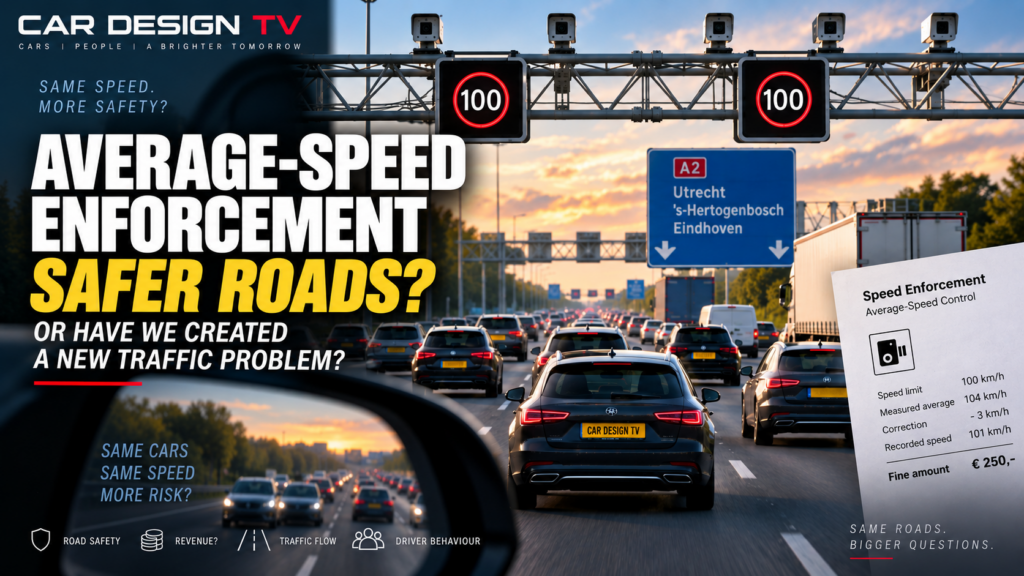
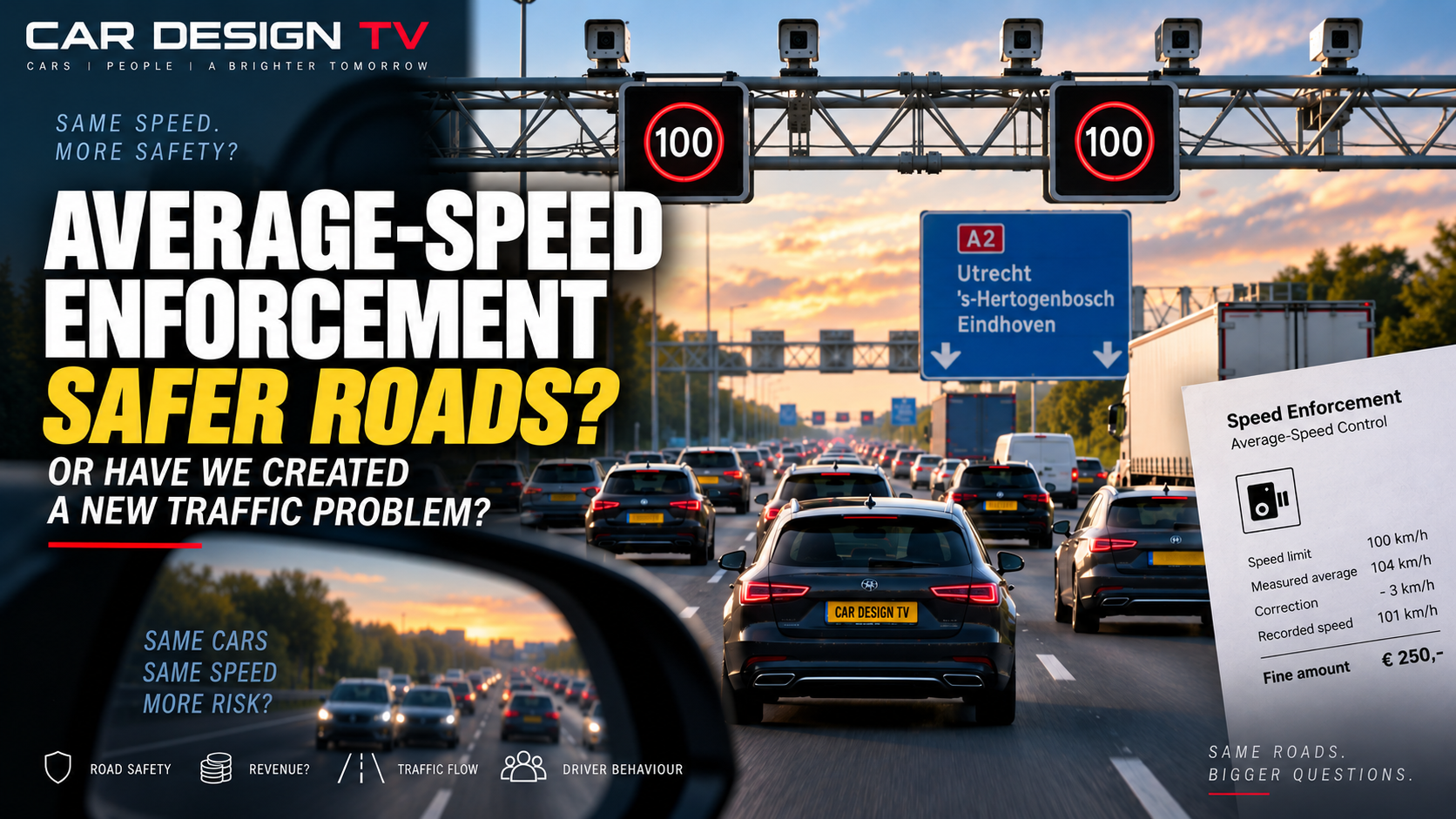
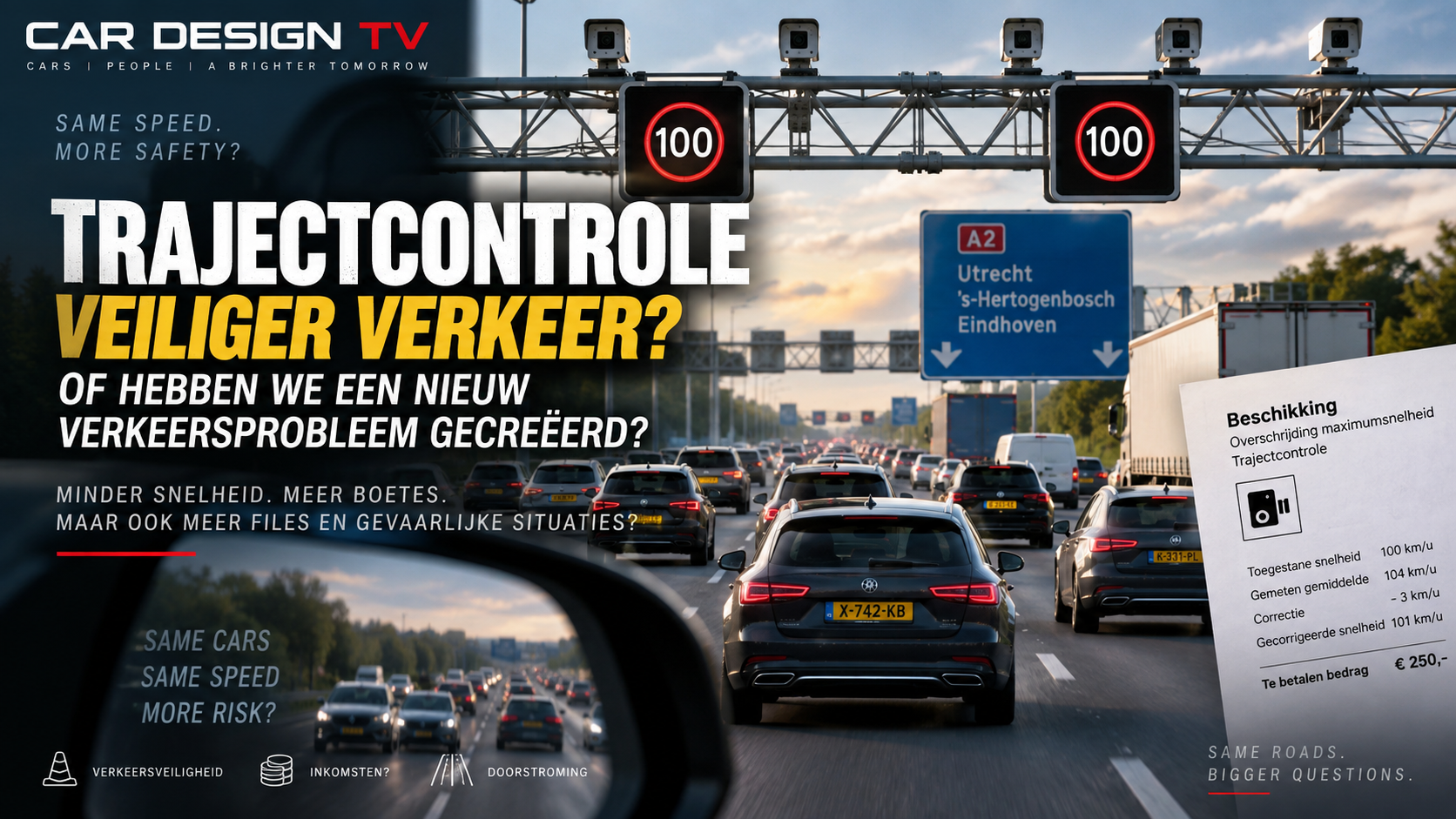
The Netherlands has turned speed enforcement into something approaching an exact science. One of its most effective tools is average-speed enforcement, known locally as “trajectcontrole.” Instead of measuring the speed of a vehicle at a single point, cameras calculate its average speed across an extended section of motorway.
The principle is difficult to argue with. Stay within the limit and nothing happens. Consistently exceed it and a fine follows. International research also provides convincing evidence that average-speed enforcement reduces speeds and can significantly reduce serious accidents.
But anyone regularly driving a busy controlled motorway such as the Dutch A2 may observe another phenomenon. And it raises a question that receives considerably less attention:
What happens to traffic safety when thousands of motorists are encouraged to drive at almost exactly the same speed?
Watching the Speedometer Instead of the Traffic
Modern cars make maintaining an exact speed extraordinarily easy. Cruise control, adaptive cruise control and increasingly Intelligent Speed Assistance allow a vehicle to travel for kilometres at almost precisely 100, 102 or 103 km/h.
That sounds ideal until Car A travels at 100 km/h, Car B at 101, Car C at 102 and Car D at 103.
On an empty motorway, that barely matters. On a busy four- or five-lane motorway containing numerous junctions, merging vehicles and substantial truck traffic, the dynamics become very different.
A driver travelling at 102 km/h and overtaking another vehicle travelling at 100 km/h can take hundreds of metres to complete the manoeuvre. Traffic accumulates behind. Another driver attempts to overtake at 103 km/h. Further ahead, a truck travelling at 85 or 90 km/h forces several streams of traffic to merge again.
The result can be a tightly packed moving cluster containing dozens of vehicles.
The Motorway Peloton
This is where average-speed enforcement presents an interesting paradox.
One of its objectives is to reduce differences in vehicle speeds. From a conventional road-safety perspective that makes perfect sense. Lower speeds and smaller speed differentials generally reduce both accident probability and accident severity.
But speed homogenisation is not necessarily the same thing as optimal traffic dynamics.
When almost everybody travels between, say, 98 and 103 km/h, the natural speed differences that ordinarily separate traffic begin to disappear. Cars remain alongside each other longer. Overtaking manoeuvres take longer. Drivers find it increasingly difficult to return to the inside lane because usable gaps disappear.
Then a truck appears ahead.
An entire line of cars wants to move left. But the next lane is occupied by vehicles travelling only marginally faster. Drivers reduce following distances to avoid losing a gap. Others briefly accelerate to complete a lane change and subsequently slow down again because they are concerned about exceeding the permitted average speed.
A system that controls speed extremely effectively may therefore simultaneously create a traffic environment in which space becomes the scarce commodity.
Speed and Safety Are Not the Same Thing
That distinction deserves considerably more attention.
Road safety is not determined exclusively by absolute vehicle speed. Following distance, relative speed, lane changes, visibility, concentration, traffic density and predictability all contribute.
A car travelling at 110 km/h on an almost deserted motorway represents a greater risk from the perspective of absolute speed than the same car travelling at 100 km/h.
But does that automatically mean that forty vehicles travelling between 98 and 103 km/h within a compact group spread across four lanes represent the safest possible traffic situation?
That is a much more complicated question.
Average-Speed Enforcement Works — But That Should Not End the Discussion
It would be incorrect to claim that average-speed enforcement has been proven detrimental to road safety. Research generally shows precisely the opposite. European studies cited by the Dutch road-safety research organisation SWOV have found substantial reductions in accidents, including serious and fatal crashes.
Consequently, dismissing the system simply as a government money-making operation is too simplistic.
But saying “average-speed enforcement reduces accidents, therefore the system is optimal” is equally simplistic.
The system measures one variable with extraordinary precision:
Speed.
It does not measure whether somebody unnecessarily occupies an overtaking lane for twenty minutes. It does not automatically penalise a driver travelling only a few metres behind another vehicle while remaining below the speed limit. It does not determine whether somebody is creating a kilometre-long queue by overtaking at 100.5 km/h a vehicle travelling at 99 km/h.
Nor does it reward the driver who briefly accelerates to resolve a traffic situation quickly, creates space and then immediately returns to the appropriate lane.
The camera sees speed.
And Then There Is the Money
The financial aspect inevitably enters the discussion.
The Netherlands issues millions of traffic penalties each year, with speeding offences representing by far the largest category. In 2023 alone, approximately 6.55 million speeding penalties were issued, with around 1.86 million resulting from average-speed enforcement.
That does not prove that these systems exist primarily to generate revenue. A policy can simultaneously generate substantial income and improve road safety.
But it does justify asking whether enforcement is always being optimised around road safety, or whether measurability and ease of enforcement have acquired too much importance.
Exceeding the speed threshold by a few kilometres per hour is extraordinarily easy to detect automatically.
Dangerous tailgating, poor merging, unnecessarily occupying an overtaking lane, aggressive lane changing or contributing to unstable traffic clusters are considerably harder to quantify.
We therefore risk creating a system in which we do not necessarily enforce the most dangerous behaviour most rigorously.
Instead, we enforce most rigorously the behaviour that is easiest to measure.
From Speed Enforcement to Traffic Management
Considering the technology now available both inside vehicles and within road infrastructure, we should be capable of thinking beyond this.
The motorway of the future does not have to be a road on which one fixed numerical speed limit is relentlessly enforced. It could become an intelligent traffic system in which speed is dynamically adapted to traffic density, weather conditions, truck traffic, merging traffic and available road capacity.
During periods of high traffic density, a lower and relatively uniform speed may indeed be the safest and most efficient solution. During extremely light traffic, a higher speed may be perfectly reasonable. And when dense vehicle clusters begin to form, intelligent traffic management could actively attempt to separate them rather than keeping hundreds of vehicles inside an extremely narrow speed window.
This is where modern ADAS, connected vehicles and ultimately Vehicle-to-Infrastructure communication become particularly interesting.
A genuinely intelligent road system would no longer ask only:
“How fast is this vehicle travelling?”
It would also ask:
“How is this vehicle behaving relative to the traffic surrounding it?”
That represents a fundamentally different approach.
Perhaps We Need a Better Definition of Safe Driving
Average-speed enforcement has demonstrable advantages. It discourages extreme speeding, produces more consistent speeds and research indicates substantial road-safety benefits. Those achievements should not be ignored.
But technology should continuously be reassessed as the vehicles using it change.
We now drive cars equipped with adaptive cruise control, lane keeping systems, automatic speed-limit recognition and increasingly sophisticated semi-automated driving functions. The behaviour of thousands of vehicles travelling along the same motorway can consequently become far more homogenised than when average-speed enforcement was originally introduced.
Perhaps, therefore, the real question is not whether average-speed enforcement should disappear.
The more interesting question is whether speed alone remains an adequate measure of safe driving behaviour.
Because ultimately the safest motorway is not necessarily the motorway on which every vehicle travels at precisely the same speed.
It is the motorway where vehicles have sufficient space, traffic flows remain predictable, overtaking manoeuvres are completed efficiently and drivers have the least possible need for abrupt braking, acceleration and lane changes.
If average-speed enforcement contributes to that objective, it is an excellent tool.
But if, under certain high-density conditions, it contributes to the formation of tightly packed moving traffic clusters, we should be willing to investigate that effect rather than assuming that compliance with a numerical speed limit automatically represents optimum road safety.
Road safety should, after all, be the objective.
Not perfect compliance with a number on a sign.